

“Do Scrum Masters coach?”
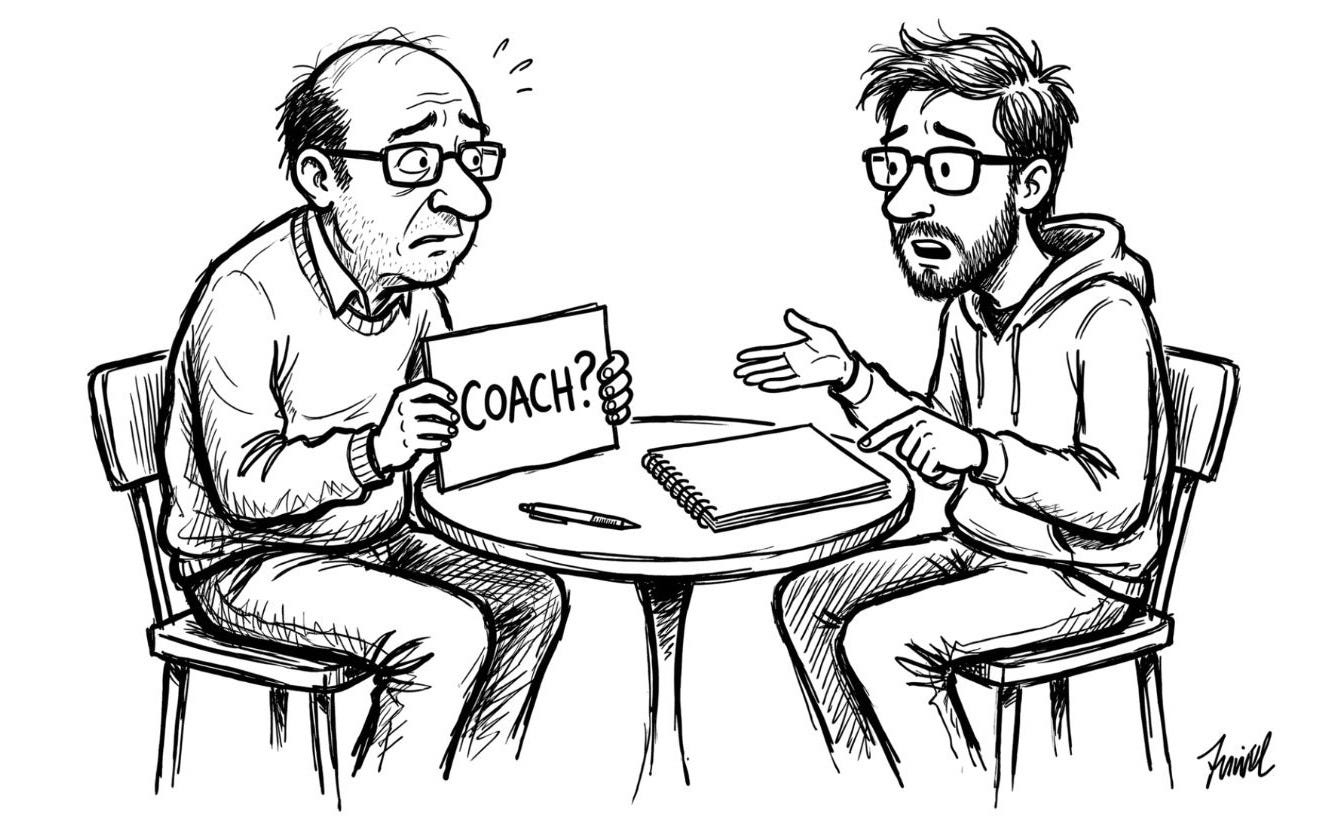
It sounds like a simple question, but it exposes a more serious dilemma about the Scrum Master role.
Some people see the Scrum Master as a facilitator
Some see them as a process curator
Some expect them to be an Agile expert
And some believe they should only ask powerful questions and never give answers
So where does coaching really fit?
Let’s find out.
Got an urgent question?
Get a quick answer by joining the subscriber chat below.

The short answer
Scrum Masters do coach, but they are not only coaches.
They coach:
the Developers on self-management, collaboration, and continuous improvement;
the Product Owner on product thinking, backlog management, stakeholder collaboration, and value delivery;
the organization on process adoption, empirical thinking, removing impediments, and creating an environment where teams can succeed.
However, Scrum Masters also need to use other “stances” when coaching is not enough.
A Scrum Master may need to:
teach Scrum when people do not understand it;
mentor a new Product Owner or Scrum Master;
facilitate events and conversations;
advise leaders on organizational impediments;
challenge behaviours that reduce transparency or accountability;
support the team in resolving conflicts;
help protect the team from harmful interference;
help the organization inspect and adapt.
So the question is not simply, “Do Scrum Masters coach?”
The question is:
“When should a Scrum Master coach, and when should they use another stance to help the team?”
Why does the dilemma exist?
The dilemma exists because coaching can be misunderstood in two opposite ways.
1. “A Scrum Master is not a coach; they are just there to ensure Scrum happens.”
This view reduces the Scrum Master to a process administrator.
In this mindset, the Scrum Master:
schedules events;
manages Jira boards;
reminds people about events;
tracks action items;
asks for updates;
reports progress;
removes small blockers.
This is a narrow and weak interpretation of the role.
A Scrum Master is not just a Scrum event coordinator. They help people and organizations become more Agile through the Scrum framework.
That requires coaching, facilitation, teaching, mentoring, and organizational change work, etc.
2. “A Scrum Master should only coach and never tell, teach, or advise.”
This is the opposite misunderstanding.
Some Scrum Masters interpret coaching as:
never giving direction;
never offering suggestions;
never correcting misunderstandings;
never teaching Scrum;
never challenging bad practices;
only asking open-ended questions.
This can also be ineffective.
For example, if a team does not understand the purpose of the Sprint Goal, it may not be helpful to only ask:
“What do you think the Sprint Goal is for?”
At some point, the Scrum Master may need to teach the purpose of a Sprint Goal, give examples, and then coach the team on how to create better ones.
Pure coaching is powerful when the person or team has enough awareness, knowledge, and ownership to discover their own solution
But when there is a knowledge gap, a misunderstanding of Scrum, or an organizational constraint, other stances may be more useful
What does “coaching” mean for a Scrum Master?
For a Scrum Master, coaching is the act of helping individuals, teams, and organizations improve their own capability to think, decide, collaborate, and adapt.
In short, they coach them to be Agile (a word no one likes to use anymore).
It is less about giving answers and more about helping people:
see reality more clearly;
inspect their assumptions;
understand the impact of their behaviour;
discover options;
make decisions;
take ownership;
learn from outcomes;
improve continuously
A Scrum Master coaches by creating awareness and enabling better choices.
For example, instead of saying:
“Your Daily Scrum is too much like a status meeting.”
They coach by saying:
“What is the team trying to achieve in the Daily Scrum?”
“Who is the conversation for?”
“How does the current conversation help the team inspect progress toward the Sprint Goal?”
The Scrum Master is not taking ownership away from the team. They are helping the team inspect and adapt.
Coaching is different from teaching, mentoring, and facilitating
One reason this becomes confusing is that Scrum Masters often use multiple stances on the same day.
#1 Coaching
Coaching helps people discover their own insights and solutions.
A Scrum Master might ask:
“What pattern do you notice in the impediments that keep coming back?”
“What conversation is the team avoiding?”
“What would change if the Developers owned this decision?”
“What outcome do you want from the Retrospective?”
Important: Coaching is useful when the team has the “ability” to solve the problem but needs reflection, awareness, or courage. It is NOT useful when the team can’t solve the problem on their own.
#2: Teaching
Teaching is useful when there is a knowledge gap.
For example:
“Let’s revisit the purpose of the Sprint Review.”
“The Daily Scrum is for Developers to inspect progress toward the Sprint Goal and adapt the Sprint Backlog.”
“A Product Backlog item is not valuable simply because it is written as a user story.”
Important: Teaching is appropriate when people do not yet understand the framework, concepts, or principles.
#3: Mentoring
Mentoring is sharing experience to help someone grow.
For example:
“When I worked with another team facing this issue, one experiment that helped was making dependencies visible earlier. Would you like to explore whether something similar could help here?”
Important: Mentoring is useful when the Scrum Master has relevant experience, AND the other person is open to learning from it.
#4: Facilitating
Facilitation helps a group have an effective conversation or decision-making process.
For example:
“Let’s separate idea generation from decision-making.”
“Let’s hear from people who have not spoken yet.”
“What decision do we need before we leave this meeting?”
“What options are on the table?”
Important: Facilitation is essential to help teams navigate VUCA
#5: Advising or consulting
Sometimes the Scrum Master provides direct advice, especially to leaders or the organization.
For example:
“If managers continue assigning work directly to Developers during the Sprint, the team will struggle to self-manage, and the Sprint Goal will lose meaning.”
Important: You gotta do what you gotta do. What you need here is COURAGE.
The Scrum Master as a coach to the team
Scrum Masters coach the Scrum team toward self-management and continuous improvement.
You are not the team’s manager. It means the Scrum Master helps the team own more of its work system.
They may coach the Developers on questions like:
How do we create a stronger Sprint Goal?
How do we plan together rather than divide work as individuals?
How do we make progress transparent?
How do we reduce dependencies?
How do we improve quality?
How do we handle conflict?
How do we hold each other accountable?
How do we inspect and adapt during the Sprint, not only at the Retrospective?
How do we stop waiting for the Scrum Master to solve everything?
A strong Scrum Master helps the team move from dependence to ownership.
The goal is for the team to become increasingly capable.
The Scrum Master as a coach to the Product Owner
Scrum Masters also coach Product Owners.
This is important because many Scrum challenges are, in fact, product ownership challenges.
A Scrum Master may coach the Product Owner on:
creating product clarity;
maximizing value;
ordering the Product Backlog;
engaging stakeholders;
saying no or not now;
making trade-offs transparent;
focusing on outcomes rather than output;
preparing for Sprint Planning;
using the Sprint Review for feedback;
avoiding proxy ownership;
collaborating with Developers
For example, if the Product Owner comes to Sprint Planning with a list of unrelated user stories, the Scrum Master may coach with questions like:
“What is the product outcome we want this Sprint to move toward?”
“How do these items connect to the Product Goal?”
“What trade-off are we making if everything is priority one?”
“What feedback do we need from stakeholders before the next Sprint?”
Here, the Scrum Master is helping the Product Owner become more effective, not taking over product decisions.
The Scrum Master as a coach to the organization
This is often the most neglected part.
Scrum Masters do not only serve the Scrum Team. They also serve the larger organization.
They coach the organization to understand that Scrum is not just a team-level process. “It exposes” organizational problems.
For example, Scrum may reveal:
too many dependencies;
unclear product strategy;
overloaded teams;
command-and-control management;
weak stakeholder engagement;
excessive work in progress;
poor technical quality;
fragmented ownership;
conflicting priorities;
lack of empowerment;
incentive systems that reward individual output over team outcomes
A Scrum Master coaches leaders and stakeholders by making these issues visible and helping the organization inspect and adapt.
This may involve uncomfortable conversations.
For example:
“The team is being asked to commit to a Sprint Goal, but new urgent work is being inserted every few days. What do we want the team to optimize for: focus or responsiveness?
This is coaching at the system level.
Coaching does not mean being passive
One common anti-pattern is the passive Scrum Master.
They say:
“The team is self-managing, so I should not interfere.”
But self-management does not mean abandonment.
A Scrum Master should not control the team, but they should actively help the team see and improve its system.
If the Daily Scrum is ineffective, the Scrum Master should not ignore it
If the Retrospective produces no change, the Scrum Master should not accept that as normal
If the Product Owner is unavailable, the Scrum Master should make the impact transparent
If leaders damage the team's focus, the Scrum Master should raise the issue
If quality is declining, the Scrum Master should help the team inspect the causes
Coaching is not silence, avoidance, or politeness.
Scrum Master must lovingly but firmly challenge the team.
The maturity of the team matters
The Scrum Master’s coaching stance should evolve with the team.
New team
A new team may need more teaching, structure, and facilitation.
The Scrum Master may explain Scrum events, clarify accountabilities, introduce working agreements, and help people understand the basics.
Growing team
A growing team may need more coaching and mentoring.
The Scrum Master can begin asking more reflective questions, helping the team own decisions and improve collaboration.
Mature team
A mature team may need more systemic coaching.
The Scrum Master may focus less on event mechanics and more on
organizational impediments,
product flow,
stakeholder alignment, and
continuous improvement
The same Scrum Master behaviour that helps a new team may limit a mature team.
For example, heavily facilitating every event may be useful early on, but over time, it may prevent the team from taking ownership.
To balance it all, you need Stance Agility
Effective Scrum Masters need stance agility.
They should be able to move between stances intentionally:
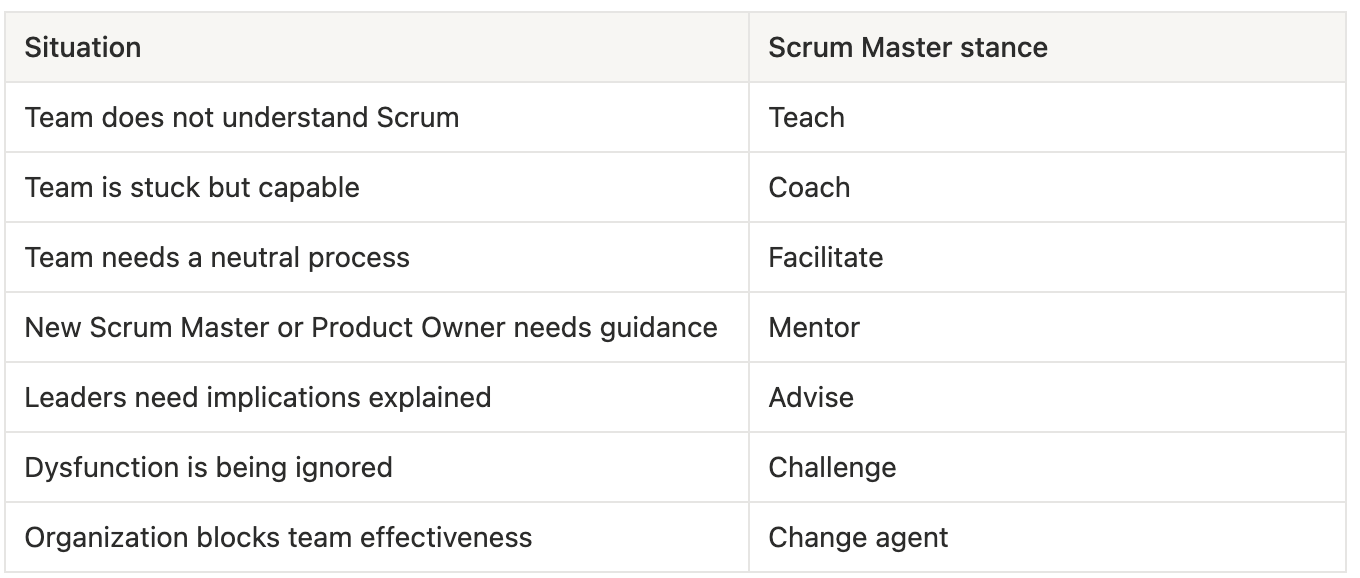
Choose the right stance for the moment.
My observation:
Some Scrum Masters over-teach because coaching feels slow
Some over-coach because direct teaching feels uncomfortable
Some over-facilitate because conflict feels risky
Some over-help because they want to be needed
What you need is to develop a “range.”
Example #1: Daily Scrum becomes a status meeting
A weak response:
“Each will answer what you did yesterday, what you will do today, and blockers.”
A coaching response:
“How is this conversation helping you inspect progress toward the Sprint Goal?”
“What would make this event more useful for the Developers?”
“Who needs to talk to whom after this?”
A teaching response may also be useful:
“The Daily Scrum is not a status report to the Scrum Master. It is for Developers to plan their work for the next day and inspect progress toward the Sprint Goal.”
The Scrum Master may need both teaching and coaching.
Example #2: Product Owner brings too many priorities
A coaching response:
“What outcome matters most this Sprint?”
“What would you choose if the team could only complete half of this?”
“What stakeholder expectation needs to be reset?”
A mentoring response:
“One technique that may help is separating urgent requests from product-value priorities and making the trade-offs visible.”
An advising response:
“If everything remains priority one, the team will likely optimize for activity rather than value.”
Example #3: Team does not improve after Retrospectives
A coaching response:
“What makes it hard for us to act on our retrospective decisions?”
“Are we choosing actions that are too large?”
“What is one small experiment we can complete within the next Sprint?”
“How will we know whether it helped?”
A facilitation response:
“Let’s select only one improvement experiment and define an owner, expected outcome, and review date.”
Example #4: Manager assigns work directly to team members
A coaching response to the manager:
“What impact do you think direct assignment has on team ownership?”
“How do you want the team to balance your requests against the Sprint Goal?”
A teaching/advising response:
“In Scrum, Developers manage how work is done during the Sprint. Direct assignment can reduce self-management and make the Sprint Goal less meaningful.”
A facilitative response:
“Let’s create a working agreement for how urgent work enters the Sprint.”
Bottomline
So, do Scrum Masters coach?
Yes. Absolutely.
But the more honest answer is this:
Scrum Masters coach in service of self-management, empiricism, and continuous improvement, not as a performance of the role, but as one of several stances they use to help teams and organizations become more effective.
A Scrum Master is not a meeting facilitator
A Scrum Master is not a process police
A Scrum Master is not only a professional coach
A Scrum Master is a change agent who uses coaching, teaching, mentoring, facilitation, and direct challenge in whatever combination the team and organization need to help people get consistently better at delivering value together.
Show your support
Every post on Winning Strategy takes 1 full day of writing. You can show your support with small gestures.

Liked this post? Make sure to 💙 click the like button.
Feedback or addition? Make sure to 💬 comment.
Know someone who would find this helpful? Make sure to recommend it.
I strongly advise that you download and use the Substack app. This will allow you to access our community chat, where you can get your questions answered and your doubts cleared promptly.
Further Reading
Connect With Me
Winning Strategy provides insights from my experiences at Twitter, Amazon, and my current role as an Executive Product Coach at one of North America’s largest banks.