
The Scrum Master Job Still Exists. It Depends Where You're Sitting
I searched 120 live job postings across India, UK, Canada, and the US. Here's what I found.

For the last three years, one of the loudest narratives in agile has been that the Scrum Master role is disappearing.
Every few weeks, another LinkedIn post declares the role dead, survey shows declining demand, and another Reddit thread fills with arguments about whether Scrum Masters ever created value in the first place.
I ran a survey 2 days ago with the readers of Winning Strategy. The responses didn't agree with each other.
Some readers say they are still seeing plenty of Scrum Master opportunities. Others are saying they couldn't find one to save their careers. Both groups are confident. Both had been reading the same headlines.
They couldn't both be right.
So I went looking.
I work as an Executive Product Coach at one of North America's largest banks, after a decade in delivery at Twitter and Amazon.
What I found was that we are not describing one job market at all. We are describing at least two.
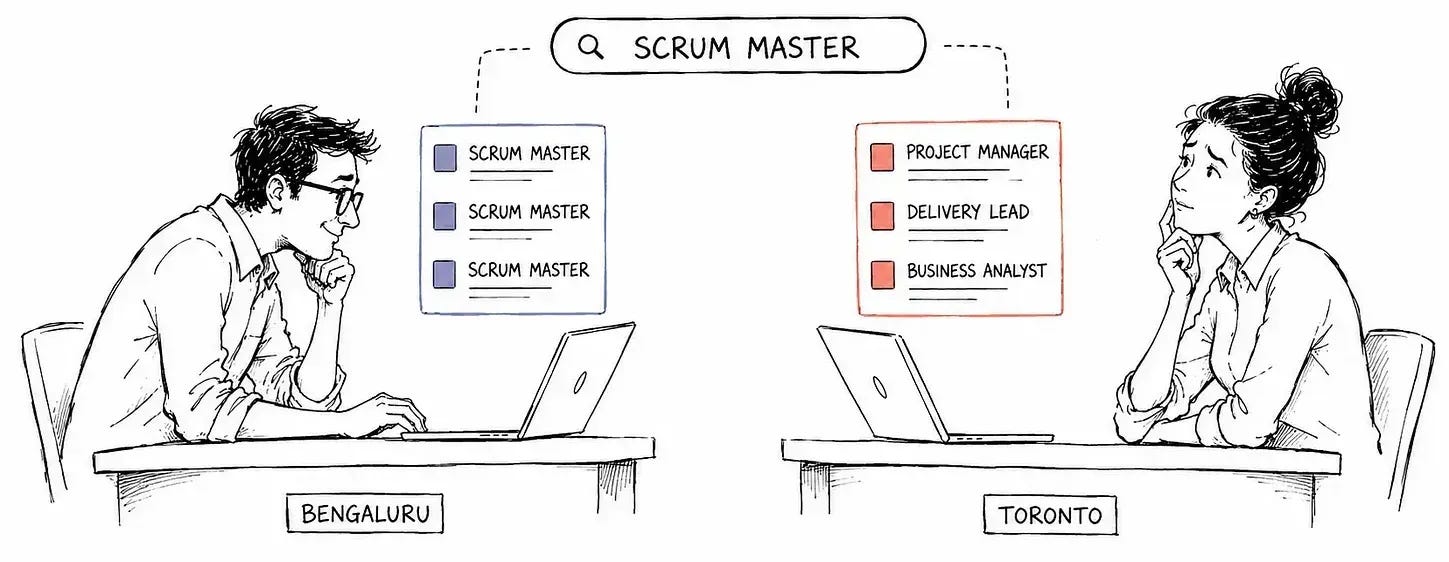
A reader in Bengaluru opens Indeed.com (or LinkedIn) and scrolls past Scrum Master openings from Infosys, Capgemini and EPAM
A reader in Toronto searches for exactly the same words and gets Project Manager roles instead
Both are searching for "Scrum Master" and looking at the same job boards. Yet they're living in completely different realities.
That difference is actually the most important point here because advice that is working in one market is actively misleading someone in another.
The Scrum Master role hasn’t disappeared everywhere.
It has simply EVOLVED differently depending on where you’re sitting.
This post provides a complete breakdown with real-time data from Indeed and LinkedIn job posting analysis that you can download here:
Research done
To test whether those survey responses reflected reality, I searched for “Scrum Master” across four markets: India, Canada (Toronto), the United Kingdom (London), Germany, Australia and the United States.
I recorded what appeared on the first page of results, noted whether postings were pure Scrum Master roles or hybrid positions, and looked for recurring themes in employers, titles and job descriptions. The searches were completed over the same period using identical search terms to make the comparisons as consistent as possible.
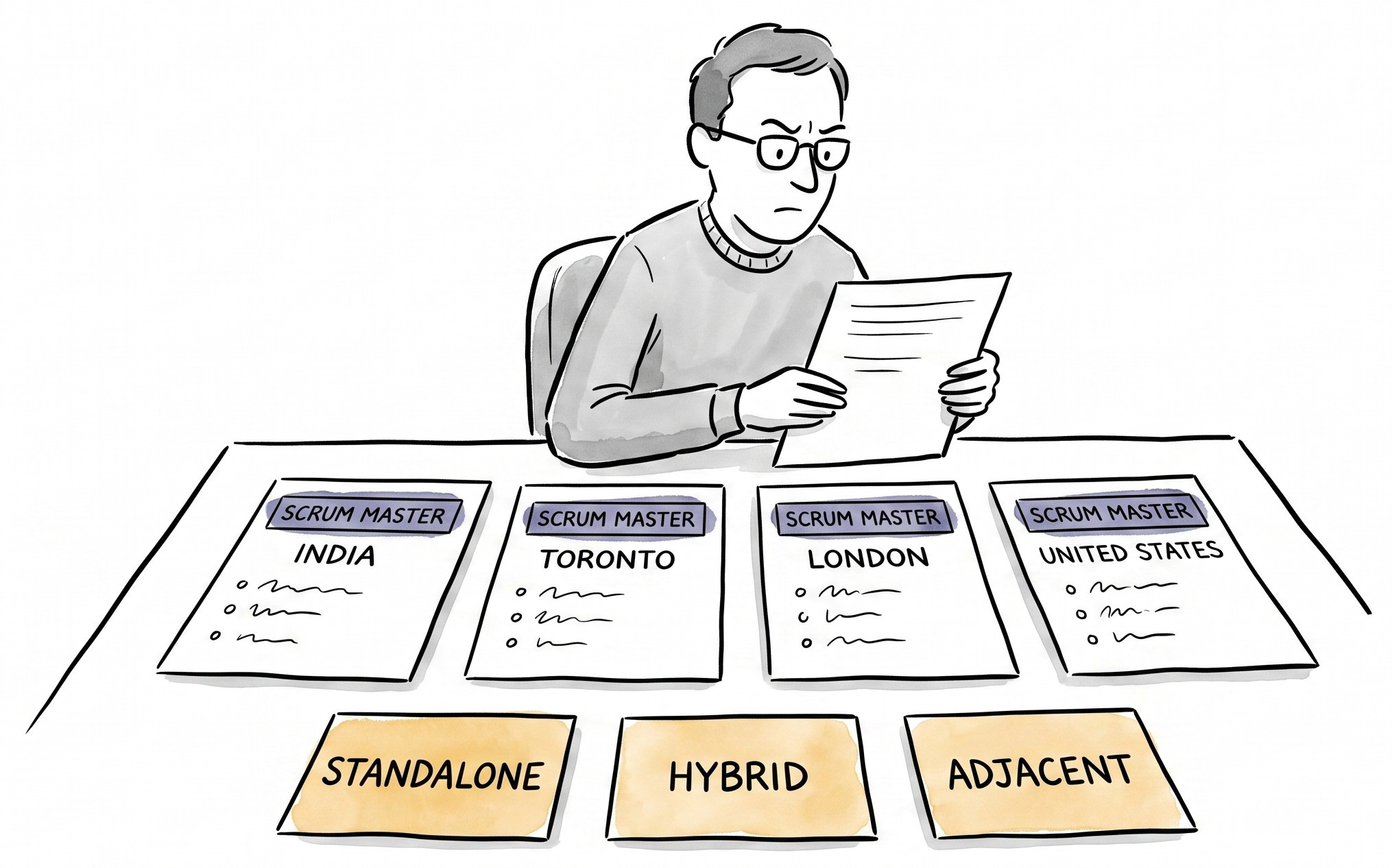
The sample of 120 job listings was enough to answer a simple grounded question.
What does someone actually see today when they search for Scrum Master jobs in different markets?
The findings were consistent.
Finding 1: India kept the title
The biggest surprise was India.
Nine out of the first ten relevant postings still used Scrum Master as the primary job title. Seven carried no qualifier at all. They were not “Project Manager / Scrum Master” or “Business Analyst / Scrum Master.” They were simply Scrum Master.
More interesting than the titles were the employers.
Infosys
Capgemini
EPAM
Alongside other large global consulting firms and Global Capability Centres.
I don’t think this is an accident.
These organizations have delivery models built around clearly defined client-facing roles. Scrum Master remains a billable position inside those delivery structures. Teams are staffed according to repeatable operating models that clients understand and purchase.
The title survives because the commercial model still needs it.
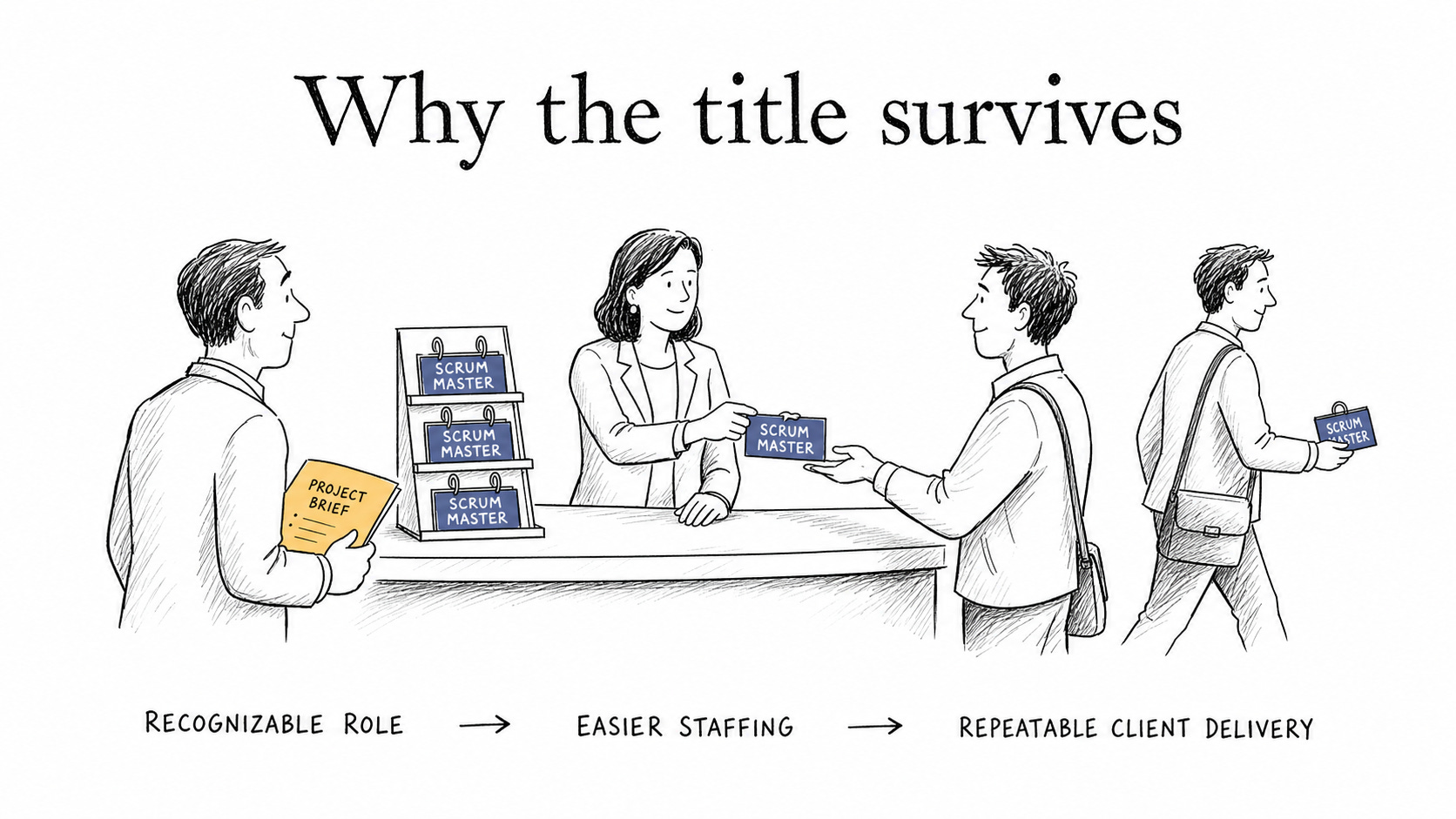
Large services firms optimize for repeatability. Clear role definitions make staffing easier and allow consultants to move between accounts without reinventing responsibilities every time.
When your organization delivers software as a service (SAAS) to external clients, specialized delivery roles retain value for longer than they do inside companies building products for themselves.
That explains why India appears to have resisted a trend seen elsewhere.
Now… it doesn’t mean the role is safer in India forever.
Ironically, many of these same firms are investing aggressively in AI-assisted delivery, automation, developer productivity tooling and leaner delivery models. The title has survived longer because the operating model supports it, not because it’s immune to the pressures reshaping software development.
It is important to understand why India is different.
It is because of the organization’s “structure,” not geography.
Finding 2: Toronto and London let it dissolve
Toronto is almost the opposite story.
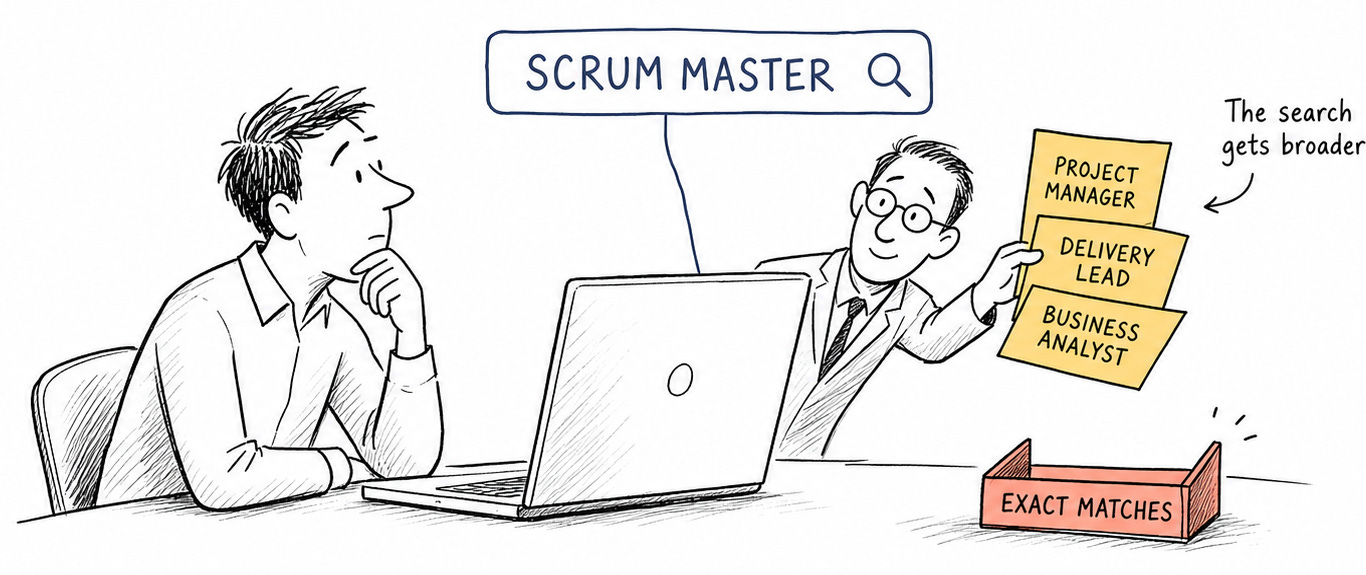
Searching for Scrum Master produced NO pure Scrum Master roles.
Instead, the results moved almost immediately toward
Project Managers,
Delivery Leads and
adjacent management positions
Indeed’s job-finding algorithm was doing exactly what job boards do when inventory becomes low.
When enough exact matches exist, they show exact matches.
When they don’t, they begin broadening the search to maximize results, and that’s exactly what happened.
London followed the same pattern as Toronto.
One genuine Scrum Master role appeared.
Then the search rapidly expanded into
Business Analysts,
Data Engineers and
unrelated delivery positions carrying only partial keyword matches.
Again, the algorithm signalled that the inventory ran out.
Also, this aligns with the broader UK hiring data I’ve seen.
Permanent Scrum Master vacancies reportedly fell from roughly 152 active postings in 2023 to around 26 during 2025.
Those exact figures may fluctuate month to month, but that’s not the point.
The direction is that the standalone Scrum Master role has become increasingly rare.
One thing to notice here:
The Scrum Master work itself HAS NOT disappeared.
Organizations still need to coordinate teams, facilitate planning, remove blockers, and ensure delivery runs smoothly. Coaching, communication, and organizational alignment are still essential parts of how software gets built. Those responsibilities haven’t gone away at all.
They’ve simply been absorbed into broader jobs.
This means:
Instead of hiring someone whose identity is Scrum Master, companies increasingly hire Project Managers, Delivery Managers or Product professionals who perform Scrum facilitation alongside everything else.
The work remains, but the title does not.
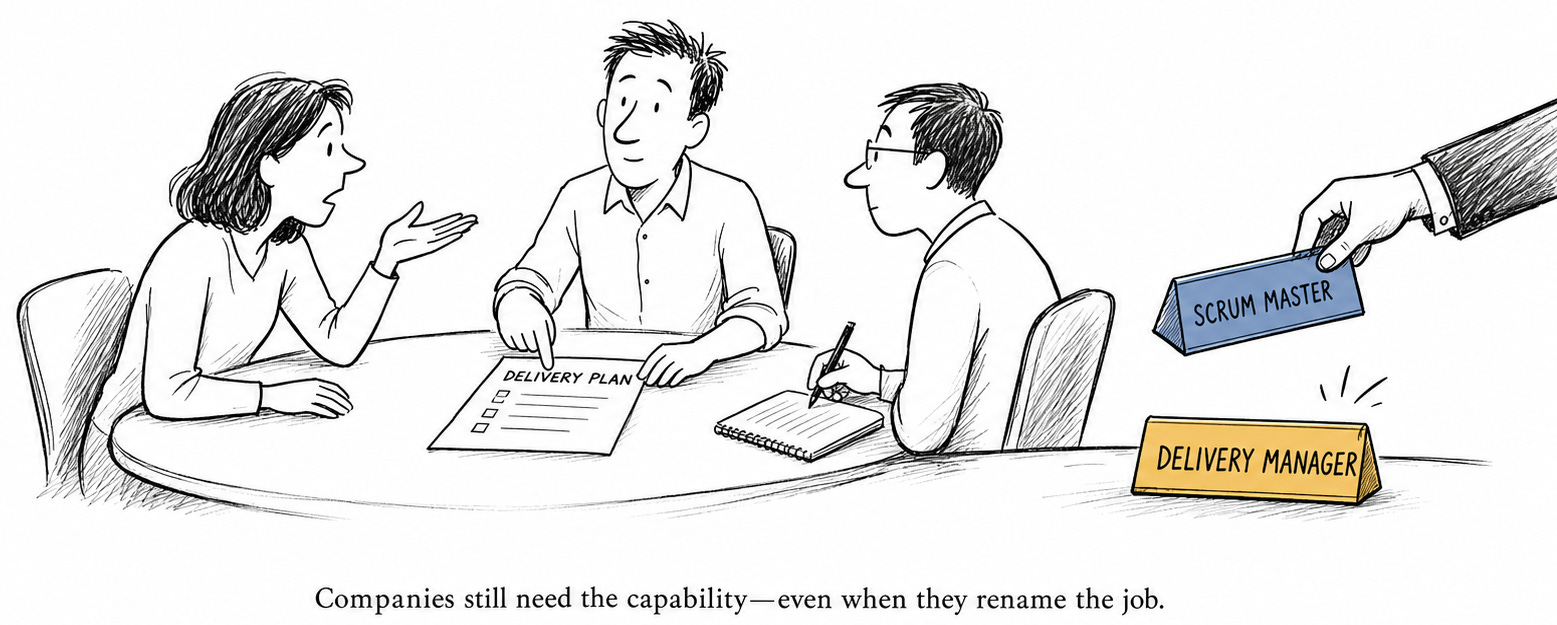
This is a very different situation than claiming that agile has disappeared.
Finding 3: The United States hybridized it
The American market landed somewhere between India and the UK.
It neither preserved the traditional title nor abandoned it entirely.
Instead, it hybridized.
Search results included titles such as:
Windchill PLM Scrum Master
Business Analyst / Scrum Master
Senior Scrum Master (RTE)
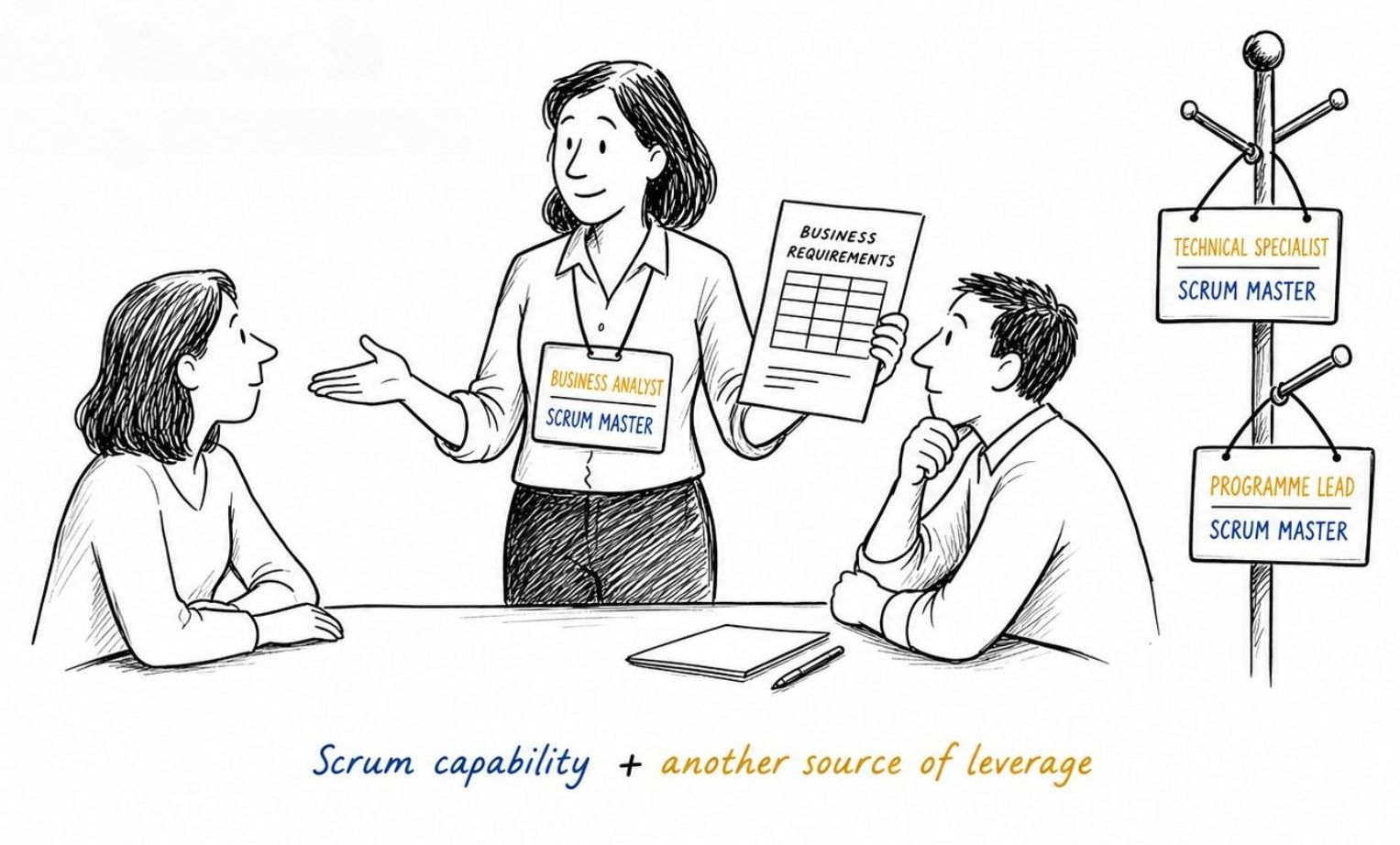
Each posting attached Scrum Master responsibilities to another organizational identity.
Sometimes the second identity reflected technical expertise, sometimes programme coordination, and sometimes enterprise-scale agile leadership.
The common thread is obvious.
Being “only” a Scrum Master is becoming increasingly uncommon.
Being something else that also performs Scrum Master work remains valuable.
This is a transition more than an extinction.
Companies still recognize the value of facilitation, coaching and delivery coordination.
They’re simply bundling those capabilities with domain expertise, creating additional organizational leverage.
If Canada represents dissolution and India represents preservation, the United States looks more like adaptation.
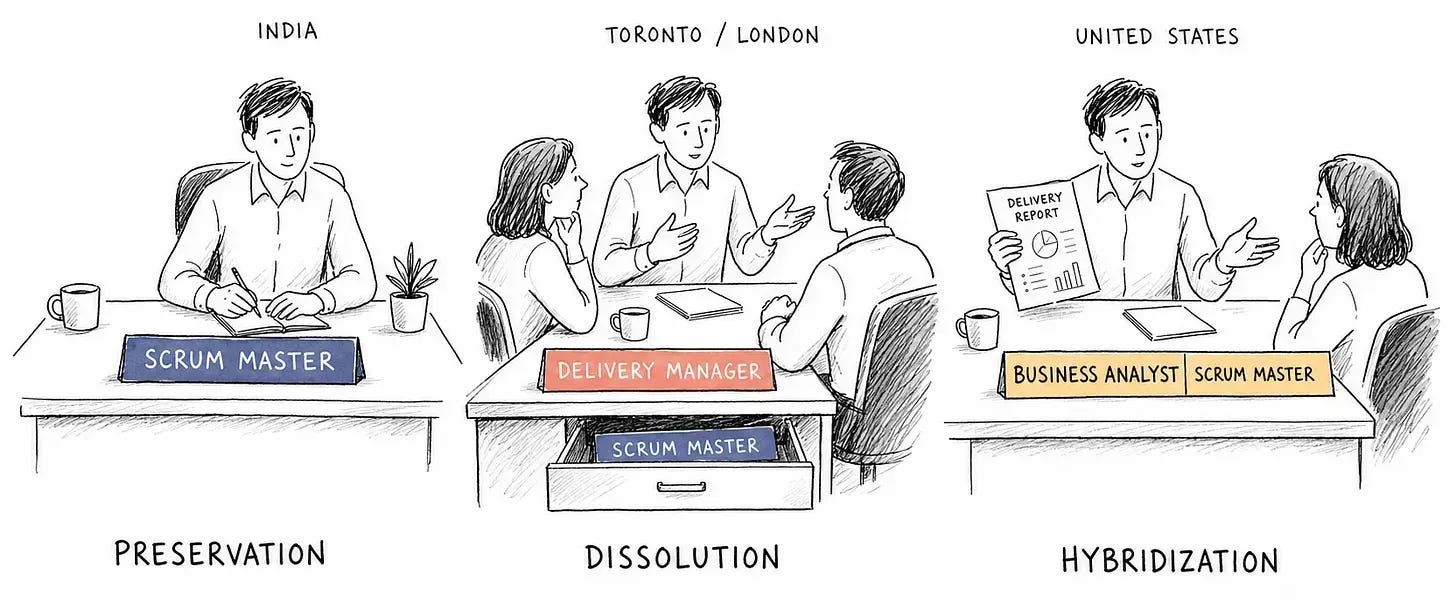
The title survives, but it is now rarely found on its own, and that’s important to understand because it shows where the Scrum Master careers are heading. It is not a move away from agile practices, but rather a change toward combining them with another professional identity that gives “the role” broader scope and relevance.
Finding 4: What the surviving Job actually asks for
One of the postings that appeared in the search results offered a clear example because it represented a genuine, standalone Scrum Master position with a detailed description.
It is a checklist of modern delivery management.
The successful candidate would facilitate Scrum ceremonies.
They would also support Kanban.
And hybrid project delivery.
They were expected to manage Jira reporting, produce Power BI dashboards, conduct risk assessments, coordinate business-as-usual work alongside strategic initiatives, and report directly to a Program Manager.
Knowledge of ITIL and PMBOK was listed alongside agile frameworks.
Seven certifications appeared under preferred qualifications.
The salary range sat between approximately $77,000 and $116,000.
Nothing in that description suggested the organization wanted a meeting facilitator.
It wanted someone capable of operating across:
delivery,
governance,
reporting,
stakeholder management and
operational execution.
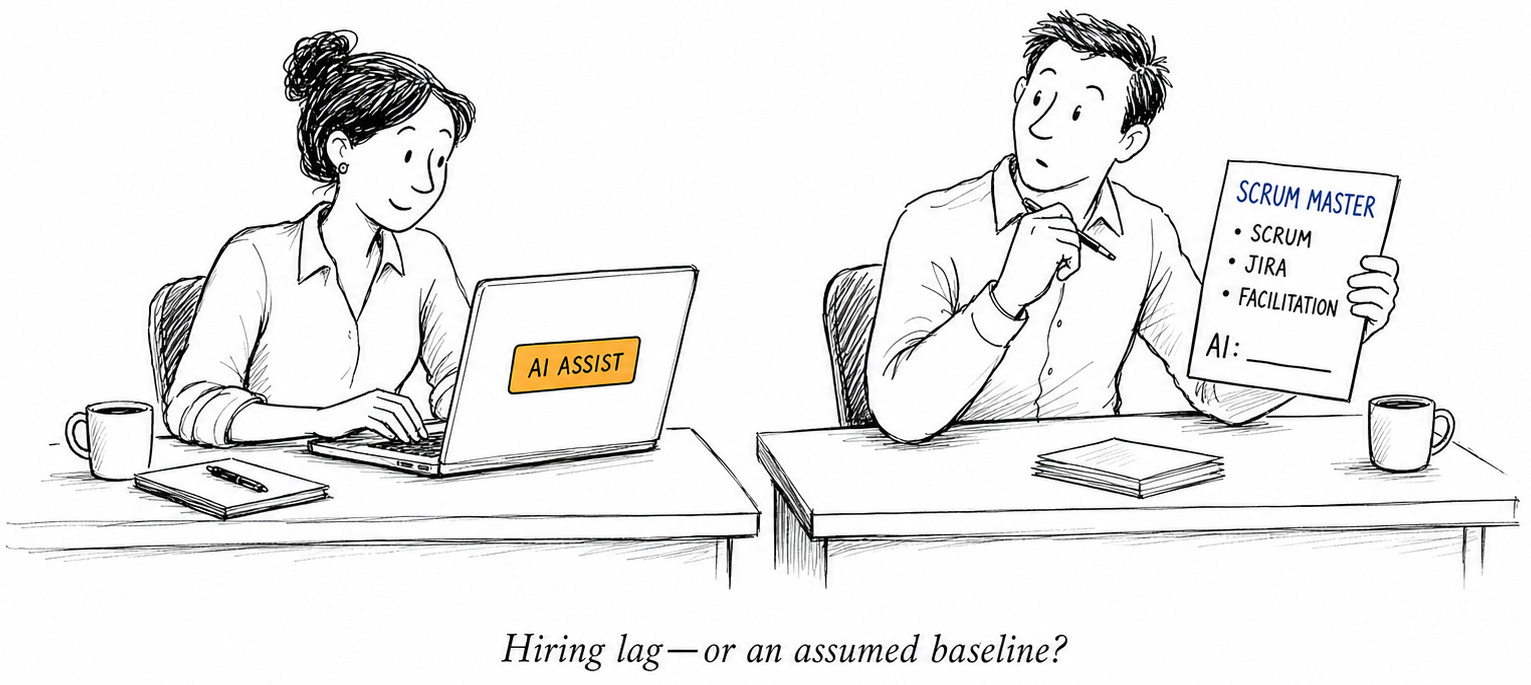
The role has expanded rather than disappeared, and as I read further I noticed something: there wasn’t a single mention of AI anywhere in the description. There were no requirements around prompting, no expectations of AI-assisted planning, no references to copilots, and no language at all about automation.
That’s shocking!!
For all the discussion about AI transforming delivery roles, this surviving Scrum Master posting still described work using vocabulary that would have looked familiar several years ago.
I am not saying or going to conclude that AI is not changing software development.
It certainly is.
What it suggests is that hiring often lags organizational experimentation.
Companies may be changing how work gets done long before job descriptions catch up.
Or perhaps…
They’re simply assuming AI literacy has become a baseline expectation rather than something worth advertising.
Either way, the absence was shocking for me.
The role has evolved dramatically.
Just not in the way many people (on LinkedIn and elsewhere) are expecting it to.
What does this mean, depending on where you are?
If you're a Scrum Master, your role isn't disappearing. However, there are a few important points to remember.
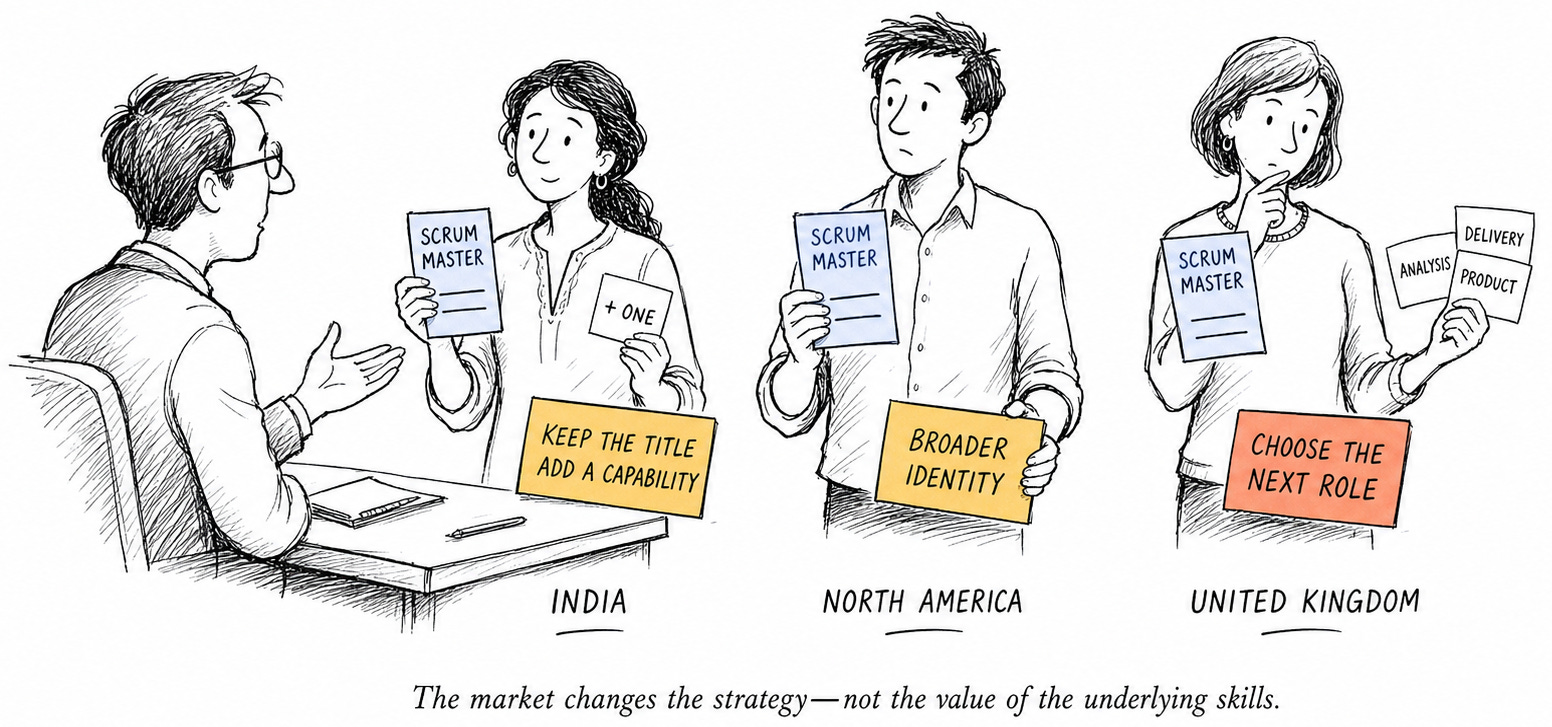
If you’re in India
The title is still alive.
That’s good news, but don’t mistake it for permanent stability.
The same consulting firms preserving Scrum Master positions are also investing heavily in automation, AI-assisted delivery and productivity improvements. Their delivery models are evolving even if the job titles haven’t caught up yet.
I’d still pursue Scrum Master opportunities there if they’re available.
But I would treat the title as today’s entry point.
Build capabilities beyond facilitation while the market still gives you the luxury of specializing.
If you’re in North America
I’d stop expecting organizations to hire you as a Scrum Master.
I DO NOT mean stop doing Scrum Master work.
Recognize where companies are buying those capabilities now.
Project Management
Delivery Management
Business Analysis
Technical programme coordination
Those are increasingly becoming the “containers” inside which agile leadership is going to live.
If your résumé still presents Scrum Master as your only professional identity, you’re probably competing in a shrinking pool.
If it presents you as someone who improves delivery while also bringing another valuable capability, you’re aligned with where hiring appears to be heading.
If you're in the United Kingdom
The standalone role of “Scrum Master” appears close to disappearing from mainstream hiring.
If you are in the UK, I’d ask a different career question.
Rather than wondering, “How do I improve as a Scrum Master?”, consider asking, “Which related role am I working towards?”
Delivery Manager?
Business Analyst?
Product Operations?
Programme Management?
Those are strategic career decisions now.
Waiting for the market to return to 2021 probably isn’t one of them.
What I'd do about it
If someone with around two years of Scrum Master experience asked me today whether they should keep going, I’d tell them YES.
BUT…
I’d also tell them to stop thinking of Scrum Master as their destination.
I’d think of it as the strongest part of a broader professional identity.
I’d become exceptionally good at “improving delivery” while deliberately building another capability alongside it.
For example:
Reporting
Product thinking
Business analysis
Programm coordination
Data
Technical literacy
It matters less which one you choose than whether you choose one deliberately.
Because that’s what employers increasingly seem to be rewarding.
Also…
I don’t think facilitation, coaching and removing impediments are becoming irrelevant.
I think they’re becoming “EXPECTED.”
Hiring Managers simply “expect” you to have that foundation.
The market appears to value people who can do those things and bring another form of leverage to the organization.
Disclaimer and downloads
This analysis is based on structured searches for “Scrum Master” conducted across India, Toronto (Canada), London (UK) and the United States during the same observation period. Results were manually coded according to whether they represented standalone Scrum Master positions, hybrid roles or adjacent job titles returned by search matching.
This is not intended as a comprehensive labour market analysis. It does not measure total vacancies, historical trends across every platform or hidden recruitment activity. It captures what a typical job seeker encounters using common search terms on major job boards
Further Reading
Scrum Master Skills in 2026 and Beyond: what’s actually worth building once facilitation stops being the differentiator and becomes the baseline everyone assumes you already have.
AI for Agile Teams: What to Automate, What to Review, and What Must Stay Human: a closer look at where AI is genuinely reshaping delivery work, even in the markets where job descriptions haven’t caught up to it yet.
Agile is 25: Which Practices Still Work in 2026 and Which Don’t?: the wider audit behind this piece’s premise: which parts of the Agile playbook have earned their keep, and which are surviving on inertia alone.
🙋🏻♂️ One question
I want to keep this data current, and I can only see what job boards show me. If you’ve searched for Scrum Master roles in the last six months, hit reply and tell me what you actually saw in your market. I read every reply, and the next version of this analysis will be better for it.
Connect With Me
Winning Strategy provides insights from my experiences at Twitter, Amazon, and my current role as an Executive Product Coach at one of North America’s largest banks.