
How to close a never ending discussion
A Facilitator's Guide to Closing Discussions That Keep Circling

Facilitating discussions is an integral part of the Scrum Master and RTE job.
Sprint planning, retrospectives, backlog refinement, PI planning breakouts, stakeholder syncs, etc. the calendar is full of conversations you’re expected to guide toward something useful.
And most of the time, you’re good at it.
You know how to open a discussion, invite quiet voices in, keep dominant voices in check, and generate options the group wouldn’t have found on its own.
But then there’s the meeting that just won’t end.
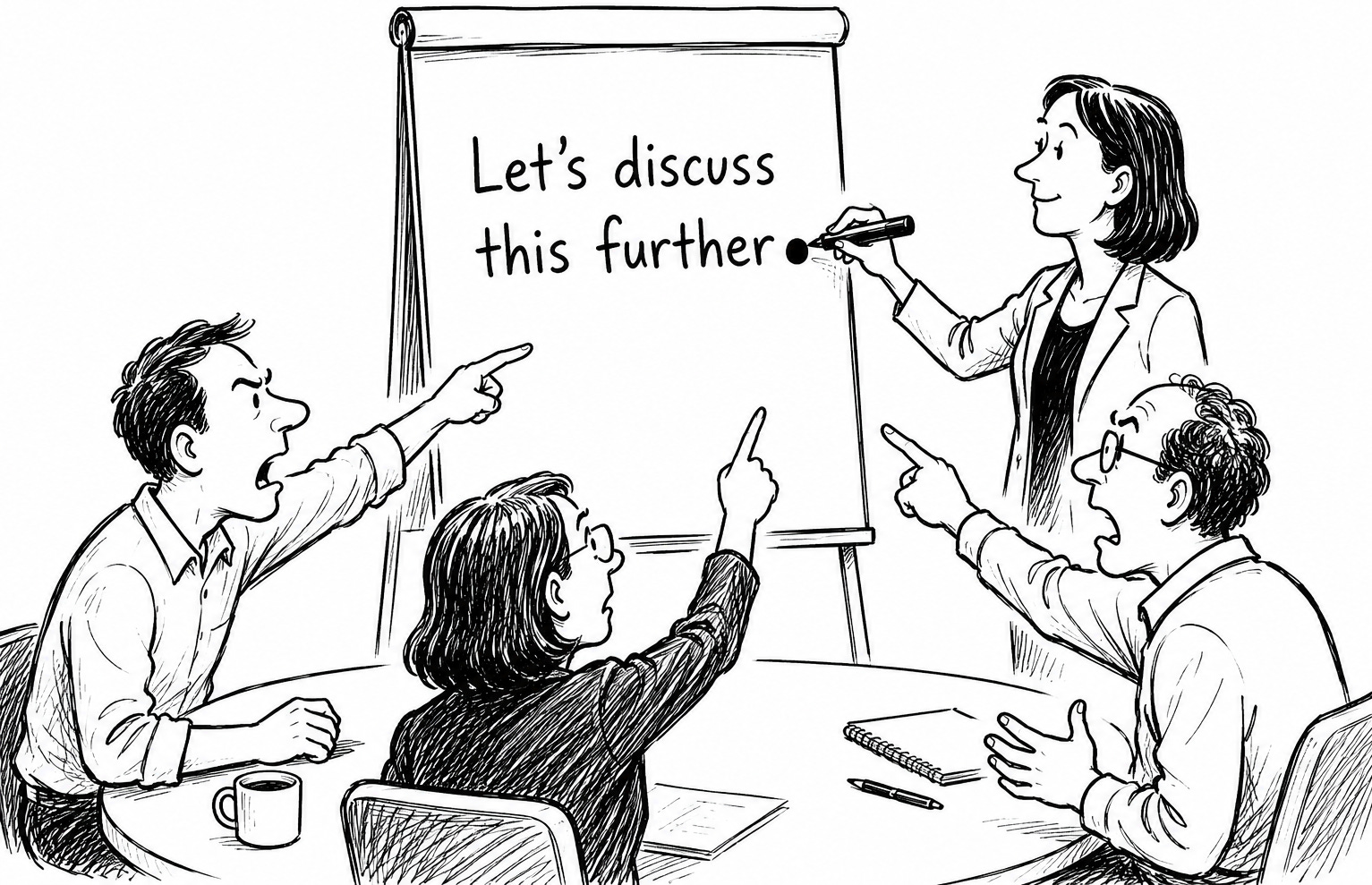
The conversation keeps circling, and the same three points keep resurfacing. Someone says “I think we’re aligned,” and five minutes later someone else reopens the exact issue that was supposedly settled. Eventually, someone suggests:
“Why don’t we continue this discussion next time?”
The problem is not necessarily that the discussion was unproductive. Often, the group simply does not know how the conversation is supposed to end.
Most of us were trained to generate divergence, i.e. brainstorming, round-robins, silent writing, but very few of us were ever given a way to converge.
Closing gets treated as an afterthought: “Okay, so... are we good?”
That question is the seed of every circling discussion you’ll ever run.
In this post, I will give you a closing sequence that you can run near the end of your discussions.
Let’s get started.
Got an urgent question?
Get a quick answer by joining the subscriber chat below.

Why do many discussions never end?
Before I give you the sequence, it’s worth naming WHY circling happens in the first place.
Most discussions go round and round when one or more of these things is missing:
No one has named what decision is actually being made. People are discussing “the problem” in general rather than a specific choice.
No one knows who decides. Is it consensus? Is it the PO? Is it the team lead? Without a decision rule, every voice carries equal veto power indefinitely.
The criteria for a good decision were never made explicit. People are silently optimizing for different things, like, for example, one person wants speed, another wants quality, another wants to protect a relationship with a stakeholder.
Concerns are being implied, not stated. People nod along in the room but raise objections in the hallway afterward.
The group conflates “agreement” with “support.” Not everyone needs to love the decision, but they do need to be willing to live with it.
There’s no plan to revisit. If a decision feels permanent and irreversible, people fight harder and longer to get it “right” the first time… which triggers circling.
The following closing sequence addresses each of these directly, in order.
Step #1: State the decision that needs to be made
Before anything else, say the “decision” out loud as a single sentence (not the topic, the decision).
Weak: “So, we’ve been talking about the deployment process.”
Strong: “The decision we need to make right now is whether we deploy on Thursdays going forward, or keep our current ad-hoc schedule.”
This eliminates a huge amount of circling because it forces the group to notice when they’ve drifted from the “decision” back into general discussion. As facilitator, this becomes your anchor line for the rest of the sequence. You’ll return to it in step 6.
Step #2: Name the decision owner or decision rule
Circling succeeds when there is ambiguity about authority.
Before the discussion starts, make the decision rule clear.
Common decision rules for Scrum contexts:
Team consent: Use when no one has a reasoned objection they’re willing to block on (not full consensus, not majority vote).
PO decides: Use for backlog/priority questions, after hearing input.
Individual/DRI decides: Use when a Directly Responsible Individual owns the call (common for technical decisions).
Scrum Master facilitates, team decides by simple majority or dot-vote: Use for process experiments.
Here's how you will say this:
“Just to be clear on how we’re deciding this: [Name] has the final call after hearing everyone out / we’re looking for consent from the whole team / we’ll dot-vote and go with the top option. Any objection to deciding this way?”
Naming the rule out loud does two things:
It lowers the emotional stakes for people who were quietly worried the discussion would drag on forever, and
It gives you, the facilitator, explicit permission to move to closure when the rule’s conditions are met
Step #3: Restate the criteria the group is using
Circling does not mean there is disagreement with the answer. Instead, it indicates disagreement over what a “good” answer should prioritize.
The next step is to play back the criteria the group has surfaced during the discussion.
Facilitator says:
“Here’s what I’ve heard matters to people in this decision: minimizing risk to the release, not adding more meetings, and keeping the on-call burden fair. Did I miss something anyone cares about?”
This step is short but powerful.
It helps uncover the underlying reasons behind someone’s resistance that might have been there all along. It’s often better to address them now rather than having them come up as a new concern just a little later.
Step #4: Bring out unresolved concerns and assumptions
This step is skipped by most facilitators.
Why?
Because it feels like it invites more circling.
But!!
Done well, it’s the opposite. It’s what allows you to close without suppressing dissent, which is exactly what prevents the decision from coming up again next week.
Ask directly, and ask twice if needed:
“Before we lock this in, what concerns or assumptions are still not resolved?
Write these down visibly.
You are not obligated to resolve every concern before deciding, but you are obligated to acknowledge it and decide what to do with it:
address now,
assign an owner to investigate, or
explicitly accept as a known risk
This step is also where you catch assumption-based disagreement, for example, two people who think they disagree but are actually just assuming different facts.
Naming the assumption usually dissolves the “disagreement” instantly.
Step #5: Test the group’s level of support
This is where you replace the vague “are we good?” with a structured, low-ego way to check where people actually stand. Using our familiar technique: fist-of-five
Fist = no, I have a serious objection
1–2 fingers = significant concern
3 = I can live with it
4–5 = fully on board
Facilitator says:
“On a scale of five, how much support do you have for [restate the decision]? Show me now.”
Critically: your goal is NOT unanimous 5s.
Your goal is that no one is showing a fist or a 1 without that concern having been heard in step 4.
A room full of 3s and 4s, with concerns already logged, is a legitimate, closeable decision. This is how you avoid manufacturing artificial consensus. You’re not asking “does everyone agree,” you’re asking “can everyone live with this, and have we heard the people who can’t?”
If you get fists, don’t force it.
Go back to step 4 briefly, ask what would move that person’s number, and decide if that’s solvable in the room or needs to be parked (see step 7).
Step #6: Confirm the chosen action and owner
Once support is sufficient per your decision rule (discussed above), close the loop by restating the decision as an action, with a named owner.
Weak: “Okay, so we’ll look into the Thursday deploy thing.”
Strong: “Starting next sprint, we deploy every Thursday by 2 pm. X owns updating the deployment checklist by Friday. Y communicates the change to the support team.”
Say it back and get an explicit nod or correction.
This is the single highest-leverage sentence in the entire meeting. It’s what people will actually remember and act on.
Step #7. Define the revisit trigger or review date
This final step makes it psychologically safe for people to let go of a decision they’re not 100% on board with, and it’s what prevents the same topic from circling back in three weeks as if nothing was decided.
Give every decision either a date or a trigger condition (or both):
Facilitator says:
“We’ll revisit this at the retro in two sprints, or sooner if [specific trigger e.g., ‘we miss a Thursday deploy window twice’]. Does that feel like the right checkpoint?”
This converts the decision from “permanent and risky” to “a considered experiment with a built-in review”
This lowers the stakes enough that people stop fighting to get it perfect on the first pass. It also gives you, the facilitator, a ready-made answer next time someone tries to reopen the topic mid-sprint:
“That’s exactly what we’ll look at during our review on [date]. Let’s capture it and hold it until then.”
Putting it together
Here’s the sequence compressed into what you’d actually say out loud, back to back:
“The decision in front of us is [X].”
“[Name] decides / we’re deciding by [rule]: any objection to that?”
“Here’s what I’ve heard matters: [criteria]: anything missing?”
“What concerns or assumptions are still unresolved?”
“Fist to five: how much support do you have?”
“Here’s what I’m hearing: [decision]. [Owner] does [action] by [date].”
“We revisit this on [date] or if [trigger]. Good?”
This takes 8–12 minutes for most team-level decisions, and it scales down easily for smaller decisions.
Show your support
Every post on Winning Strategy takes 1 full day of writing. You can show your support with small gestures.

Liked this post? Make sure to 💙 click the like button.
Feedback or addition? Make sure to 💬 comment.
Know someone who would find this helpful? Make sure to recommend it.
I strongly advise that you download and use the Substack app. This will allow you to access our community chat, where you can get your questions answered and your doubts cleared promptly.
Further Reading
Connect With Me
Winning Strategy provides insights from my experiences at Twitter, Amazon, and my current role as an Executive Product Coach at one of North America’s largest banks.