
You were a Great Scrum Master. Then your Company adopted SAFe.
Learning SAFe as an Experienced Scrum Master

Q: “Hi Vibhor, I’ve been a Scrum Master for a Scrum Team for 6 years, and I understand Scrum reasonably well through hands-on experience. Now my organization has adopted SAFe, and I’m trying to understand how to learn it without feeling overwhelmed by all the new roles, events, artifacts, and terminology. How should I approach learning SAFe in a practical way?”
Thank you for the question.
The first thing I tell every experienced Scrum Master is that you are not starting from zero.
SAFe is built on top of Scrum, not instead of it.
Your team-level practices like Sprint Planning, Daily Scrum, Sprint Review, Sprint Retrospective, and the Product Backlog don’t disappear in SAFe. They remain the engine room of delivery.
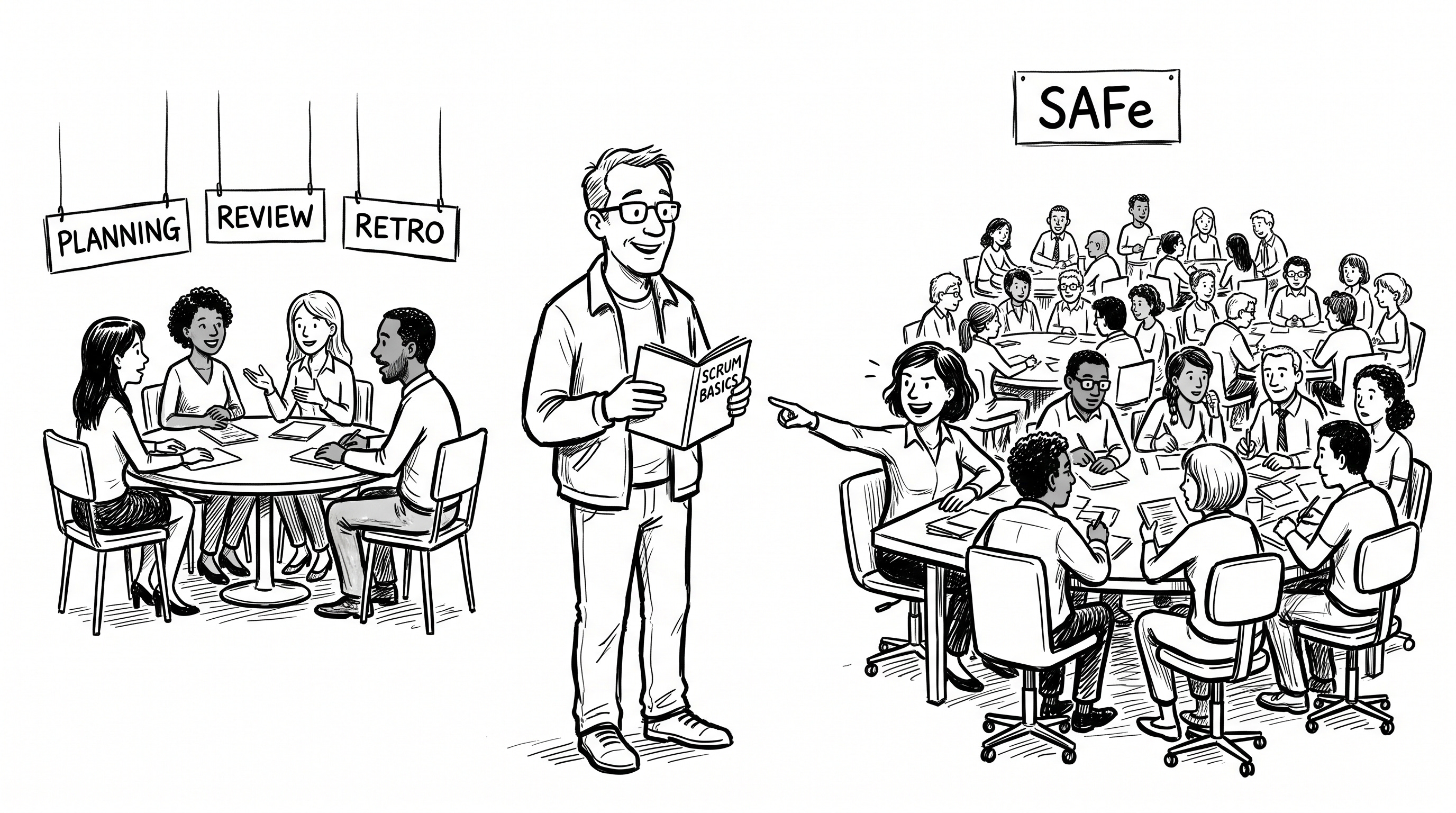
What SAFe does is add layers of coordination around that engine room so multiple Scrum teams can work together toward a shared, larger goal. So instead of learning SAFe as something new, try learning it as Scrum+.
The simplest mental model to adopt here is this:
Scrum = how one team plans, builds, and inspects its own work
SAFe = how multiple Scrum teams synchronize their planning, building, and inspecting so they can deliver value together
Every time you meet a new SAFe concept, the question you ask is this:
“What Scrum concept is this scaling up?”
Having said that, let’s look at how you can approach SAFe step by step, connect it with your Scrum Master experience, and build confidence without getting lost in the terminology.
Let’s get started.
Got an urgent question?
Get a quick answer by joining the subscriber chat below.

Understanding new SAFe roles, events, and artifacts
Rather than memorizing the glossary, map each new SAFe element to something you already do.
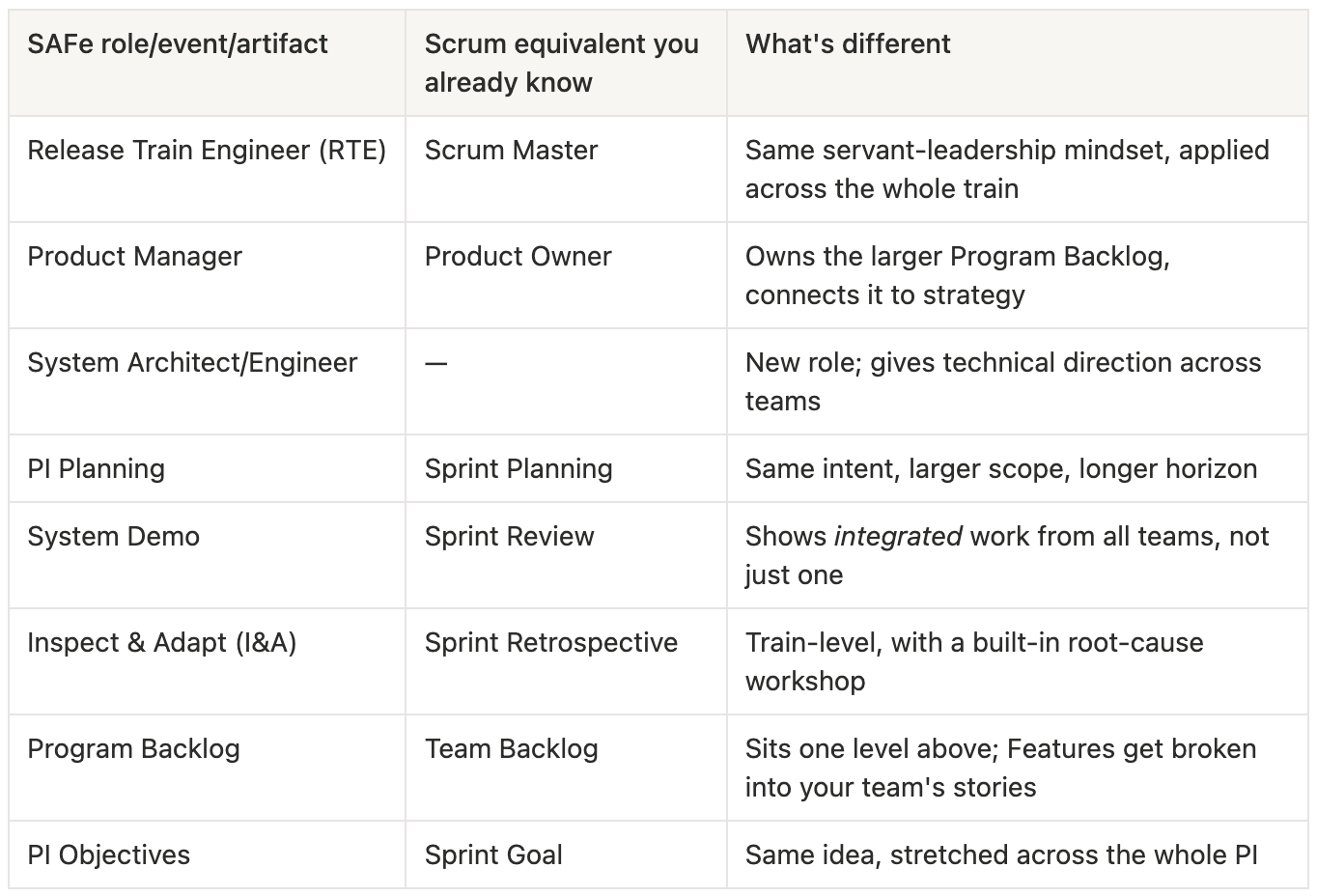
Also…
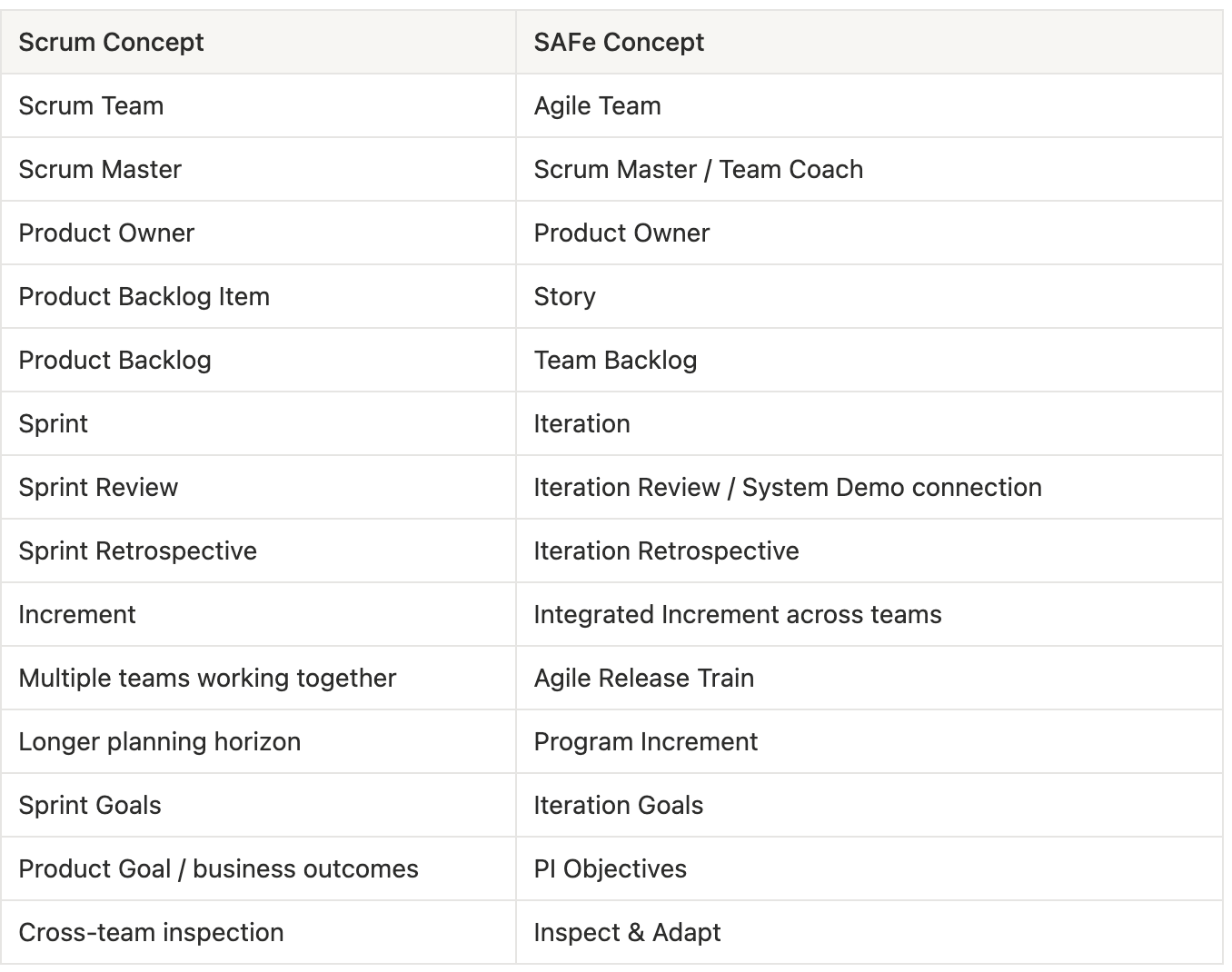
This mapping helps reduce anxiety.
SAFe has more layers because it is dealing with more complexity. But many ideas are not completely new. They are scaled versions of things you already understand.
Where to start learning?
One reason SAFe feels overwhelming is that it introduces all the above concepts at once. The mistake many people make is trying to learn everything with equal importance.
I would learn SAFe in layers instead.
1. Start with the team level
Begin with the parts closest to your current Scrum Master role.
At the team level, you will still see things that are familiar to you:
Agile Teams
Iterations
Iteration Retrospectives
This is your comfort zone. Start by asking.
“How is my Scrum Team expected to operate inside SAFe?”
2. Then understand the Agile Release Train
The next important concept is the Agile Release Train (ART).
An ART is a long-lived team of Agile Teams. Instead of one Scrum Team working independently, several teams are aligned to a shared mission, product, value stream, or solution.
The ART introduces roles such as:
Multiple Product Owners
Multiple Scrum Masters or Team Coaches
RTE is someone who facilitates and supports the train in a way similar to how a Scrum Master supports a team, BUT at the ART level.
This does not mean the RTE is simply a “Scrum Master of Scrum Masters.”
No!
But the service, facilitation, coaching, and impediment-removal mindset is the same.
3. Then learn the planning and feedback events
Once you understand the ART, focus on (the major) cadence-based events.
For example:
These events help multiple teams align, coordinate, review integrated work, and improve together.
As a Scrum Master, you already know the value of Sprint Planning, Daily Scrum, Sprint Review, and Sprint Retrospective. SAFe adds larger-scale versions of planning, synchronization, review, and improvement.
4. Finally, learn portfolio and enterprise concepts
Do you absolutely need to learn about these?
Yes and No.
Do not start with portfolio terms unless your role requires them immediately. But do start your learning on these.
Concepts like:
Lean Portfolio Management
Portfolio Kanban
Epics
Strategic Themes
Enterprise Architecture
These concepts are important, but they may not be the first things a team-level Scrum Master needs to master.
Learn what is closest to your daily work first. Then expand outward.
Avoiding overwhelm from SAFe terminology
SAFe has a lot of terminology. Some of it is useful.
Don’t make it a vocabulary exam for yourself
I want you to treat every term as an answer to a practical scaling problem.
For example:
“Why do we need PI Planning?”
Because multiple teams need to align on a shared direction, identify dependencies, discuss risks, and create a plan for the next planning horizon.
“Why do we need an ART?”
Because a single team may not be able to deliver the full customer value. Several teams may need to work together continuously.
“Why do we need a System Demo event?”
Because reviewing only team-level work may not show whether the integrated solution is actually working.
“Why do we need Inspect & Adapt event?”
Because improvement should not happen only within individual teams. The whole train also needs to inspect results and adapt its ways of working.
“Why do we need PI Objectives?”
Because teams and stakeholders need a shared understanding of the outcomes the teams intend to achieve during the Program Increment.
When you connect terminology to the problem it solves, the terms become less intimidating.
Term → Purpose → Problem it solves → How it connects to Scrum
For example:
PI Planning → Align multiple teams → Reduces dependency and priority confusion → Similar in spirit to Sprint Planning, but across teams and a longer horizon.
This makes learning sense.
Moving from team-level Scrum to scaled agility
This is more a mindset change than a knowledge change.
As a Scrum Master, your accountability has largely been to one team. In SAFe, your team’s success is now tied to the TRAIN’s success.
Now:
you’ll coordinate more with other Scrum Masters and the RTE around dependencies
your Sprint Goals will need to visibly connect to the train’s PI Objectives, and
you’ll start asking not just “is my team improving?” but “is my team improving in a way that helps the train deliver?”
That means paying attention to:
Shared goals
Integration challenges
Release constraints
Architectural decisions
Business priorities
Risks that affect multiple teams
Communication between Product Owners
Alignment between teams and stakeholders
A Scrum Master in a scaled environment should still protect team health and agility, but not in a way that isolates the team from the larger system.
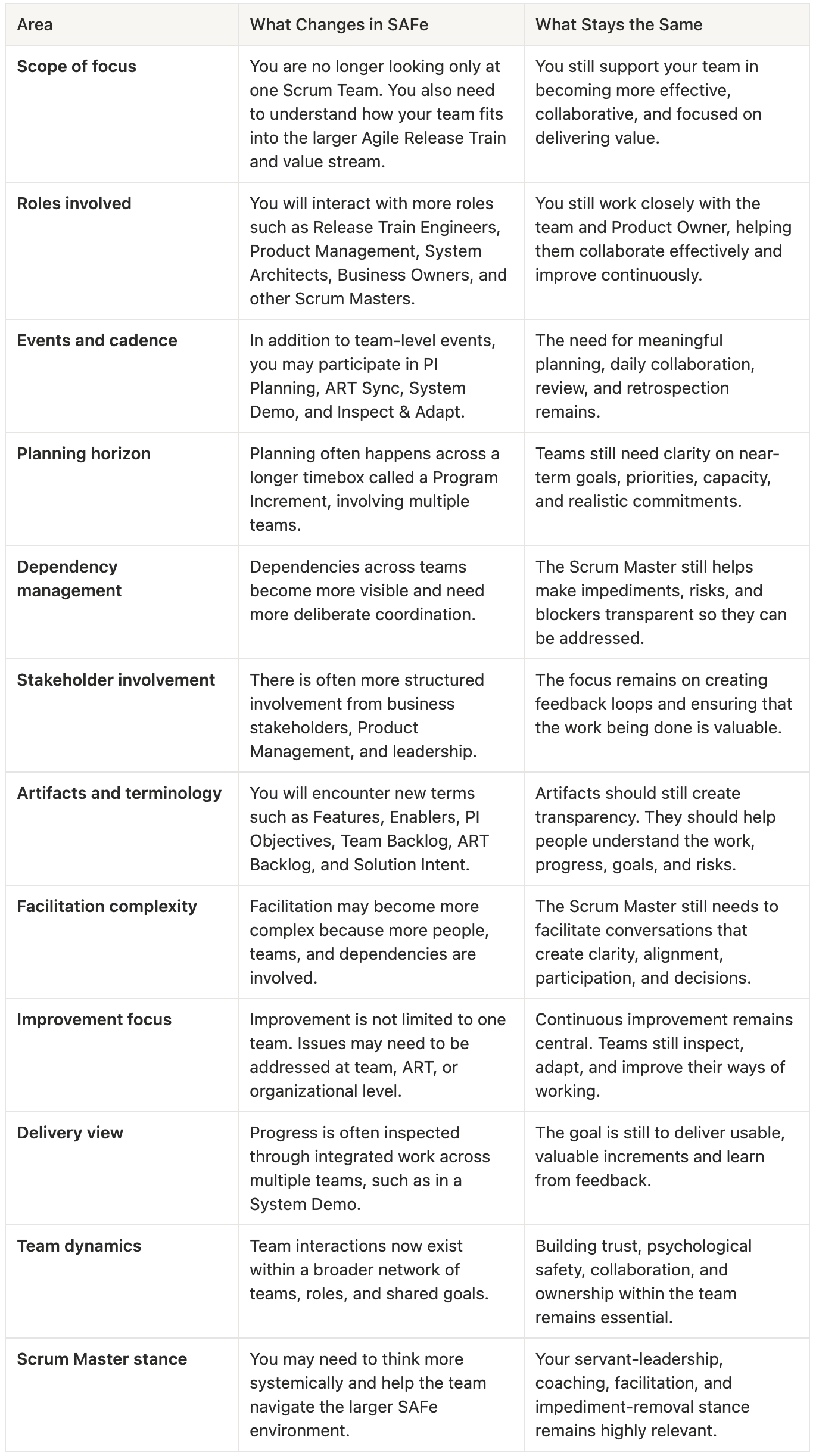
Knowing what changes and what stays the same
When moving from Scrum to SAFe, it is important to understand that not everything changes.
SAFe needs strong Scrum Masters because scaling weak agility only creates larger weak agility.
If teams do not understand collaboration, ownership, feedback, quality, and continuous improvement, scaling will not solve that problem.
Best practices for new SAFe Scrum Masters
Once you’ve got the structural pieces of SAFe sorted, the roles, the events, and the cadence, the real work begins.
Understanding the framework gets you in the room; how you operate within it is what actually makes you effective as a Scrum Master at scale.
The following practices will help you stay true to what made you a good Scrum Master in the first place, even as your scope of influence grows. Here’s where to focus your energy.
1. Focus on outcomes, not ceremonies
A common pitfall in SAFe adoption is becoming event-driven.

Usually you will hear people ask:
Did we conduct PI Planning?
Did we hold the System Demo?
Did we update the board?
Did we write PI Objectives?
These are NOT enough.
As a Scrum Master, you should help people ask better questions:
Did PI Planning create alignment?
Did the System Demo generate useful feedback?
Did Inspect & Adapt lead to real improvements?
Did the ART reduce risks?
Did teams deliver integrated value?
Did stakeholders make timely decisions?
Did we improve flow?
Did customers benefit?
This is where your Scrum Master coaching becomes powerful.
2. Build relationships beyond your team
In Scrum, you already work with the team and Product Owner.
In SAFe, you need to build relationships with other Scrum Masters, the RTE, Product Management, System Architects, Business Owners, and other teams.

Your influence expands through relationships.
A scaled environment depends heavily on collaboration. The better your relationships, the easier it becomes to remove impediments, resolve dependencies, and create alignment.
3. Use communities of practice
SAFe environments often have Scrum Master CoPs. I talked about these in my last post:

If you have these CoPs available in your organization, you must use them actively.
Discuss questions such as:
How are other teams handling PI Planning?
What makes a good PI Objective?
How are dependencies being visualized?
What patterns are emerging in retrospectives?
How can Scrum Masters support System Demos?
How can we improve Inspect & Adapt?
Where is the ART struggling?
What coaching stance is needed with leaders?
You do not need to learn SAFe alone.
4. Keep the Agile values alive
The danger in any scaled framework is that people may prioritize process compliance over Agility.
Your role is to keep bringing the conversation back to values and outcomes with the help of these questions:
Are we delivering value?
Are we learning quickly?
Are we improving quality?
Are teams engaged and empowered?
Are stakeholders collaborating?
Are we adapting based on evidence?
Are we reducing complexity where possible?
Are we making work visible?
Are we improving the system?
That is the heart of your contribution.
So… how to learn SAFe as a NEW SAFe Scrum Master?
DO NOT abandon Scrum. Expand your perspective.
Scrum gives you a strong foundation in empiricism, facilitation, team coaching, continuous improvement, and value delivery. SAFe adds structures for alignment, planning, coordination, and improvement across multiple teams.
So do not try to learn SAFe as a huge collection of terms.
Learn it as a set of answers to scaling questions:
How do multiple teams align?
How do they plan together?
How do they manage dependencies?
How do they demonstrate integrated progress?
How do they improve the larger system?
How do they connect team execution to business outcomes?
If you approach SAFe this way, it becomes much less overwhelming.
Show your support
Every post on Winning Strategy takes 1 full day of writing. You can show your support with small gestures.

Liked this post? Make sure to 💙 click the like button.
Feedback or addition? Make sure to 💬 comment.
Know someone who would find this helpful? Make sure to recommend it.
I strongly advise that you download and use the Substack app. This will allow you to access our community chat, where you can get your questions answered and your doubts cleared promptly.
Further Reading
Connect With Me
Winning Strategy provides insights from my experiences at Twitter, Amazon, and my current role as an Executive Product Coach at one of North America’s largest banks.