
6 Ways to Translate Technical Debt Into Product Decisions
How to get buy-in for technical debt

Q: “My team often raises technical debt concerns, but the conversation becomes too technical for the Product Owner and business stakeholders to respond, so they ignore it. How can I help translate technical debt into product language so the Product Owner and leaders can make informed choices about what to accept?”
Based on your question, I don't think anyone is being difficult.
A team says, “We need to refactor this module.” The Product Owner hears, “Engineering would like some time to tidy up the code.”
The developer is right about the code. The PO is right that they have a roadmap and about eleven weeks (for example) of capacity to fill it. The team describes a system, and a Product Owner needs a decision, and those are two entirely different conversations.
So the technical debt sits there.
Another quarter goes by. Everyone agrees it's getting worse, and nobody does anything, because "getting worse" is not a thing you can prioritize.
It is not that one group cares about quality while the other cares about value. Both groups are talking about value, but they are using different languages.
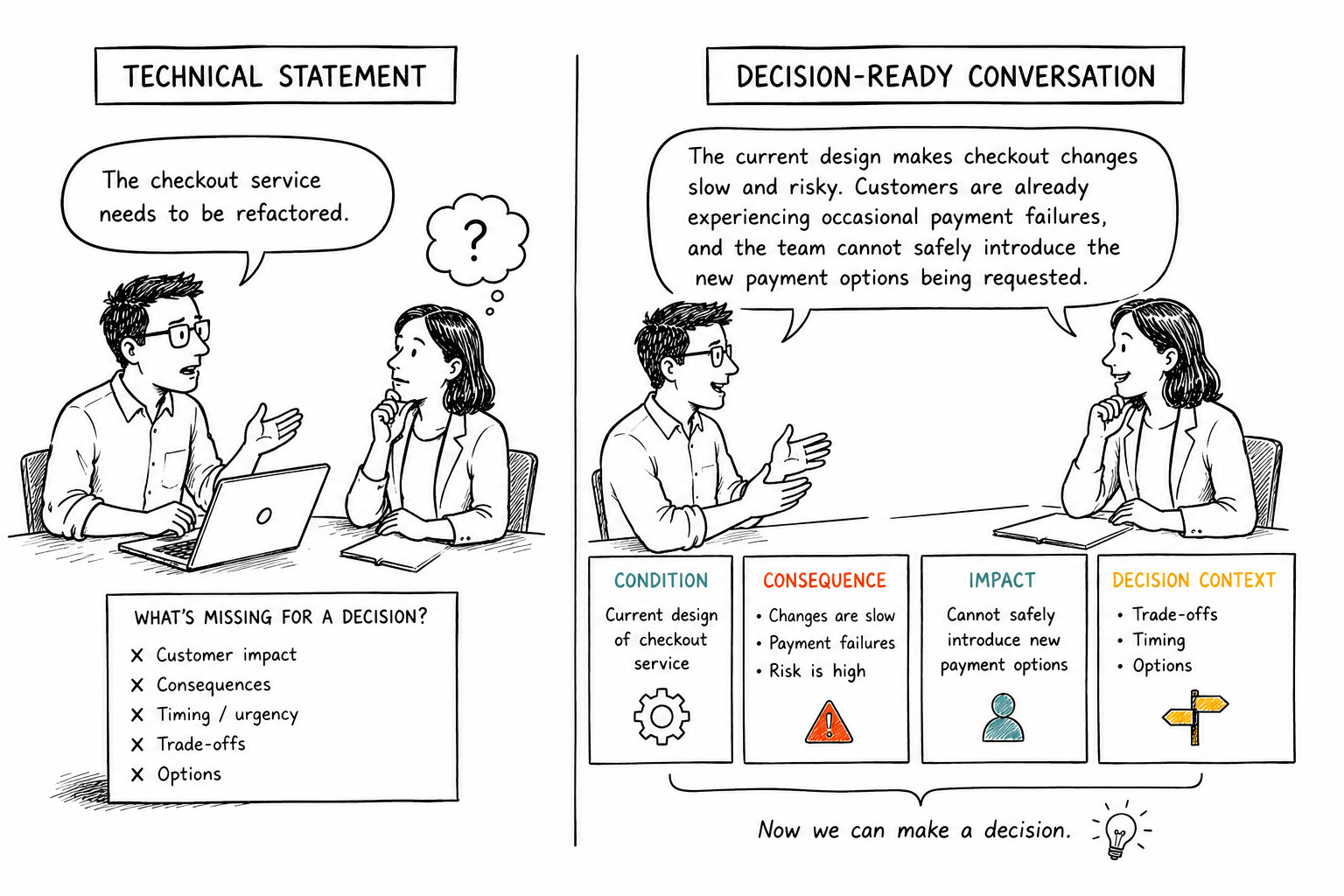
Developers describe the “internal condition” of the product
Product Owners and leaders need to understand the “consequences” of that condition
How do we fix this?
We are not going to make technical debt sound less technical. Also, it is NOT your role to become an interpreter carrying messages between “engineering” and “the business.”
No!
Your role is to help the people involved have a better decision-making conversation.
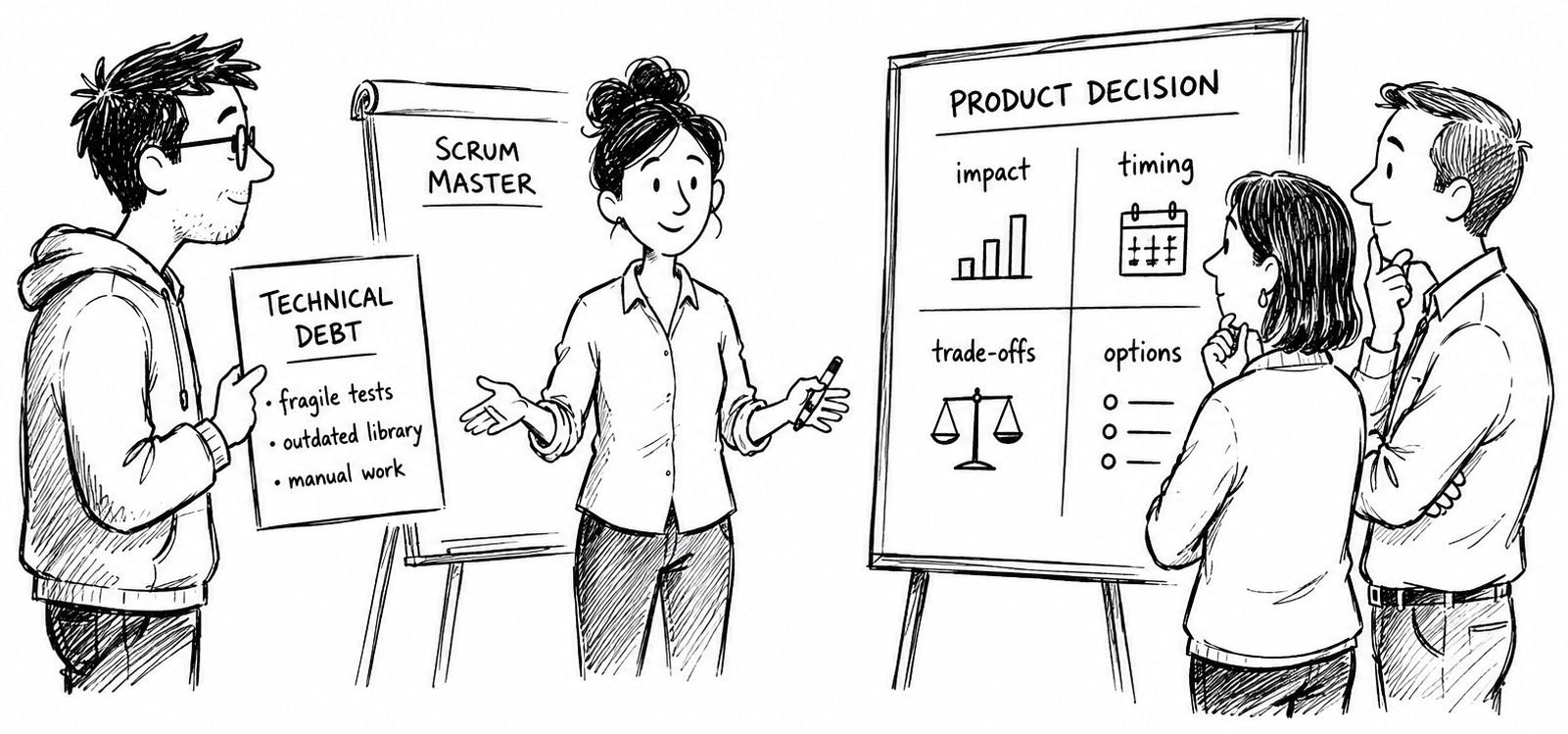
In this post, we discuss 6 ways of doing just that.
Let’s get started.
Got an urgent question?
Get a quick answer by joining the subscriber chat below.

#1: Customer Impact
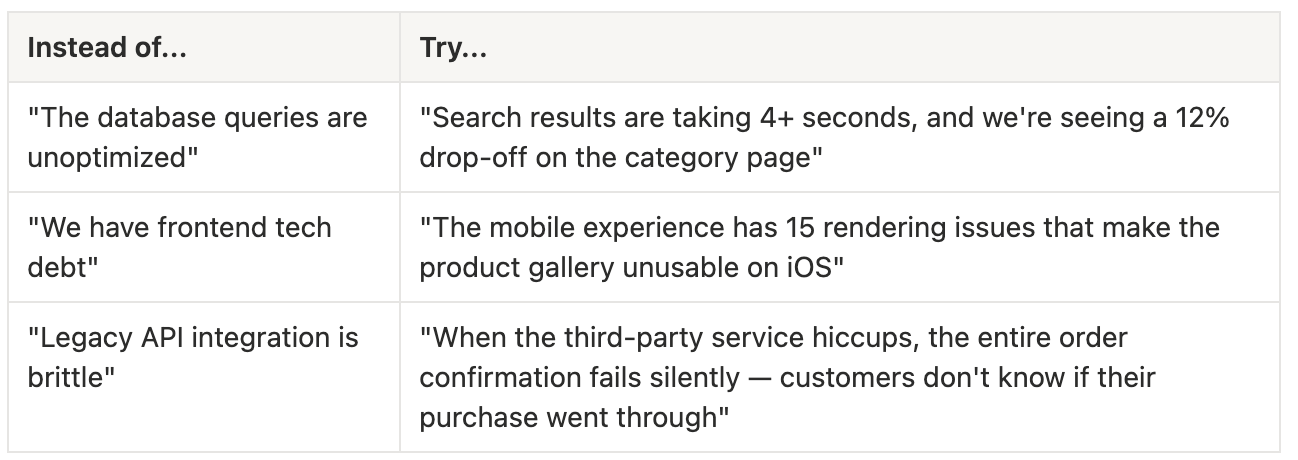
Present technical debt as a degradation in customer experience.
Product Owners think in journeys, not architectures.
They understand "checkout is slow" or "users can't reset passwords on mobile." They do not intuitively connect that to "tight coupling between the user service and the legacy monolith."
Scrum Master’s Role:
Pair with the team to map technical debt items to specific user pain points. Use analytics, support tickets, or NPS feedback to quantify the customer impact. If you can’t draw a line from the debt to a user-facing symptom, the Product Owner is right to question its priority.
Decision-ready question:
“If we do nothing, which customer experience degrades first, and how many users does it affect?”
#2: Delivery Delay
Convert technical debt into time and predictability costs.
Product Owners live by forecasts and commitments.
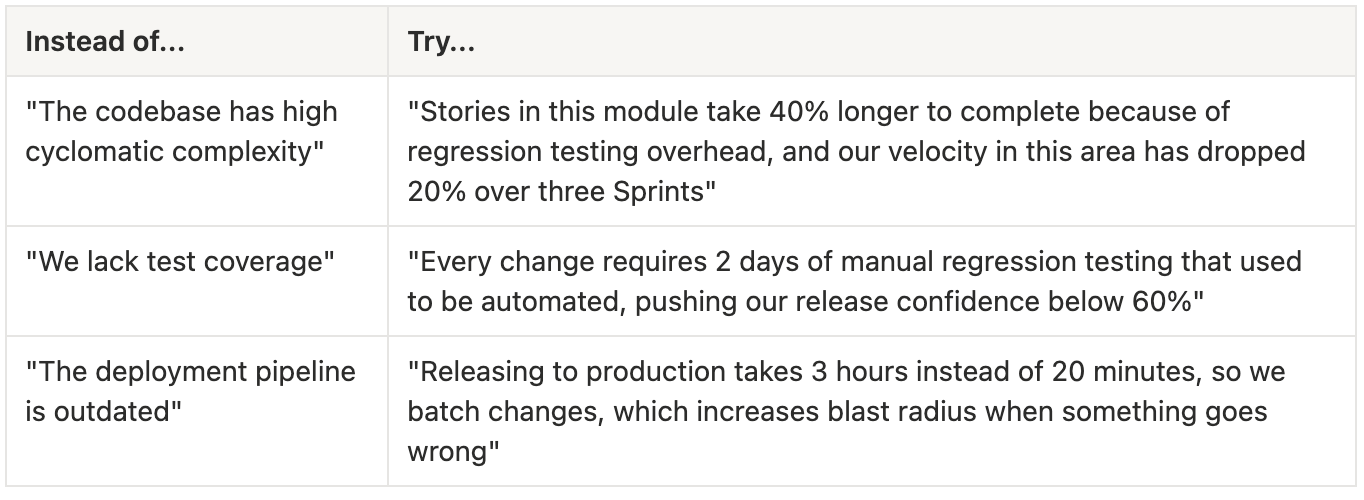
They need to know if the team can deliver Feature X by the end of the PI. When debt creates drag, it doesn't only slow one story; it injects uncertainty into every estimate.
The cost of this tech debt is scattered across the work. It appears as:
an extra day of testing,
a deployment that requires specialist help, or
a change that has to be reopened because of an unexpected dependency.
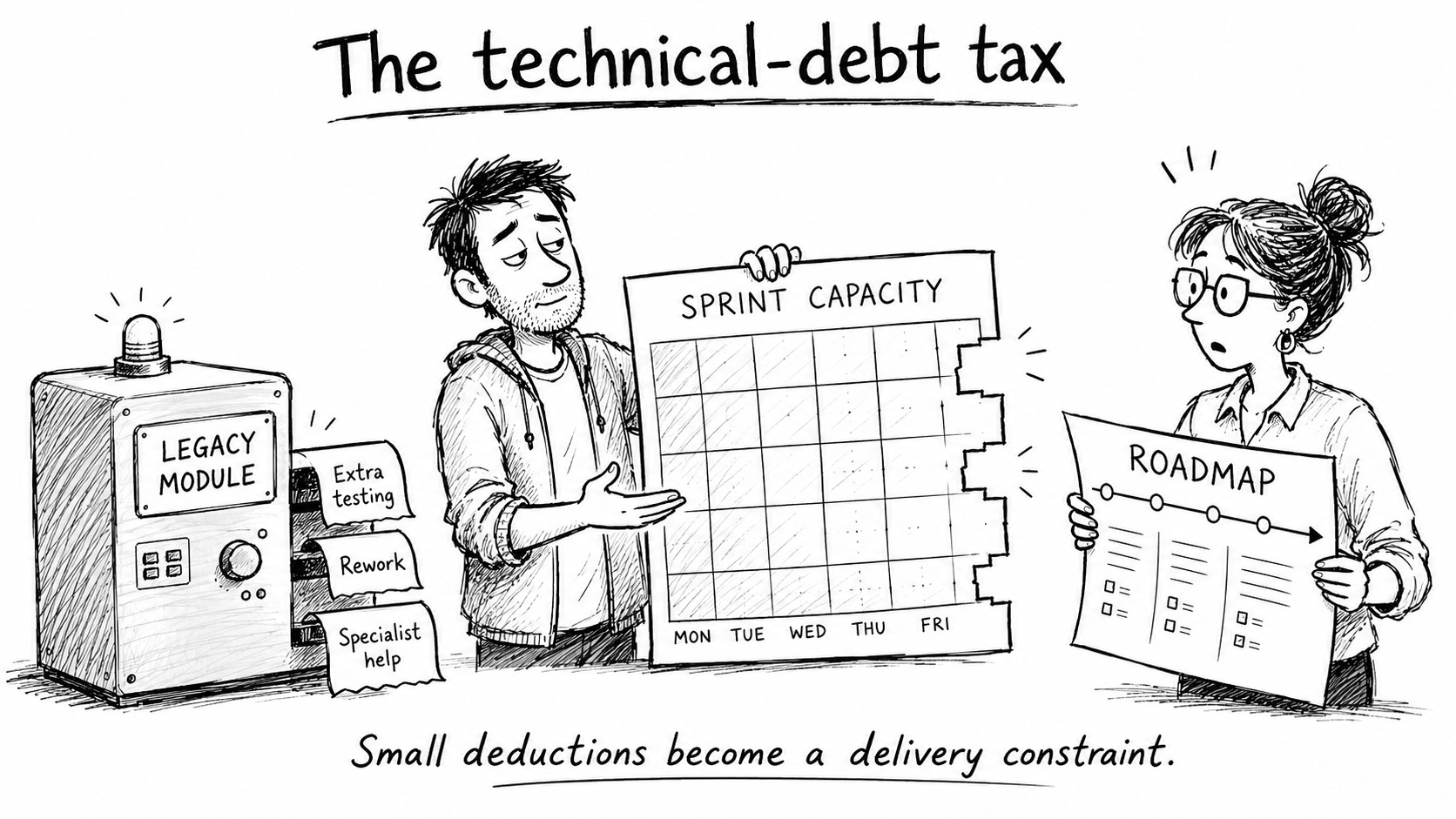
Each of these looks manageable on its own, which is exactly why none of them ever gets raised as a problem.
Developers often feel this drag long before anyone else can see it. Their frustration is real, but “the code is getting harder to work with” is not enough to support an investment decision.
This drag becomes visible (to stakeholders) through relevant evidence.
For example:
Repeated carryover between Sprints
A growing amount of rework
Frequent regression defects
Delays caused by manual processes
Too much time spent diagnosing rather than developing
etc.
Although no single metric proves that technical debt is the cause, you can use the data to support the business case and start an investigation.
The Scrum Master’s Role:
Help the team measure the drag. Track cycle time, rework rate, or escaped defects per area of debt. Show trends, not snapshots. A Product Owner can debate opinion; they can’t debate three Sprints of velocity decline.
Decision-ready question:
“If we fix this debt, how much faster (and more predictably) can we deliver the next three roadmap items?”
#3: Operational Risk
Present technical debt as an incident waiting to happen.
“What could go wrong in production?”
Examples of such tech debt include:
etc.
Calling any of this "risky" will not move a leader, because risk on its own is an abstraction.
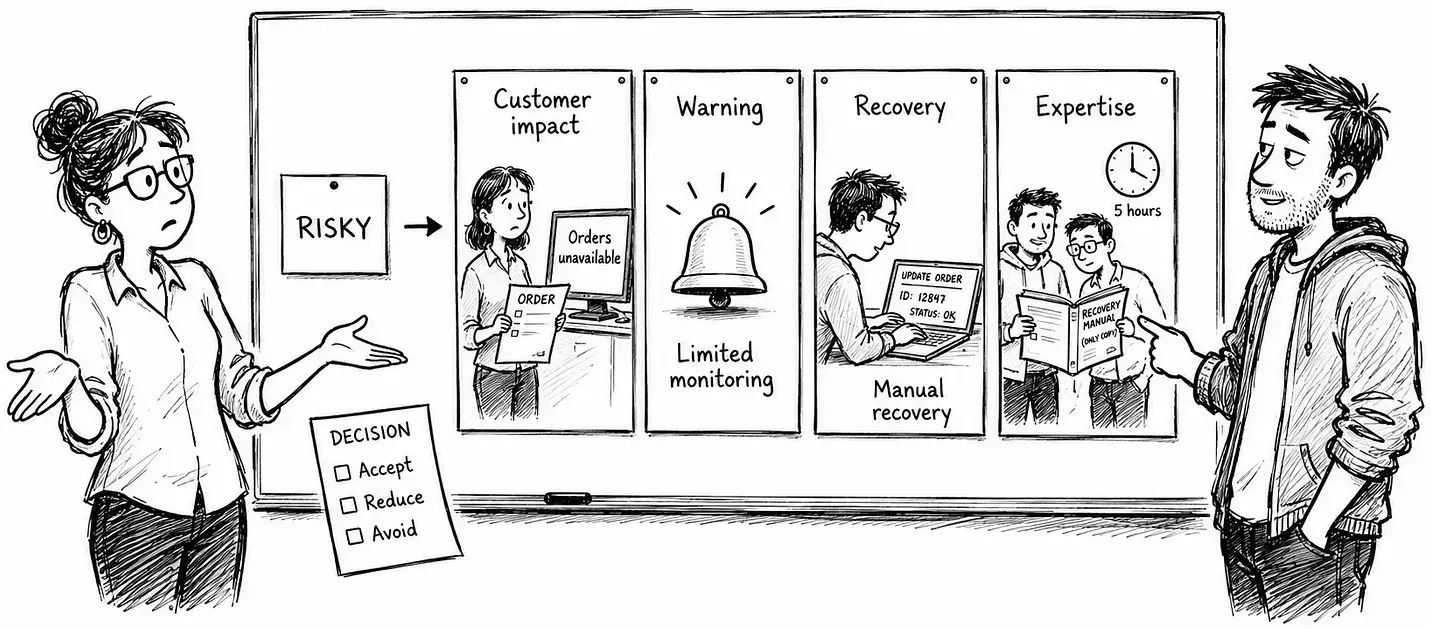
Product Owners understand risk when it's translated into business continuity terms: outages, SLA breaches, regulatory violations, or brand damage. Technical debt that creates operational fragility is a liability on the balance sheet.
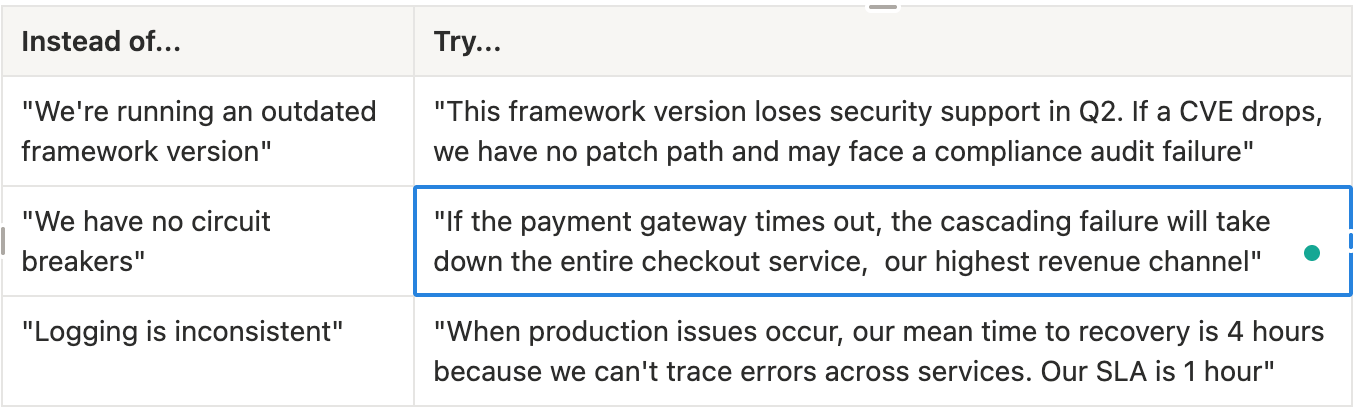
Presenting like this addresses everything a decision-maker needs, because it answers four questions in order:
What could happen?
Describe the failure scenario.How likely is it to happen?
Use incident history, observed warning signs, or engineering judgment.How serious would it be if it happens?
Consider customer harm, lost transactions, security exposure, regulatory impact, and recovery cost.How prepared are we if it happens?
Explain monitoring, rollback, recovery, and available expertise.
The Scrum Master’s Role:
Work with the team to run a lightweight risk assessment.
Use a simple matrix: probability of failure × business impact.
Invite the Product Owner to a 30-minute session where engineers walk through “what happens if this breaks on Black Friday?”
Decision-ready question:
“If this debt triggers a production incident, what’s the worst-case business impact, and do we have a mitigation plan?”
#4: Opportunity Cost
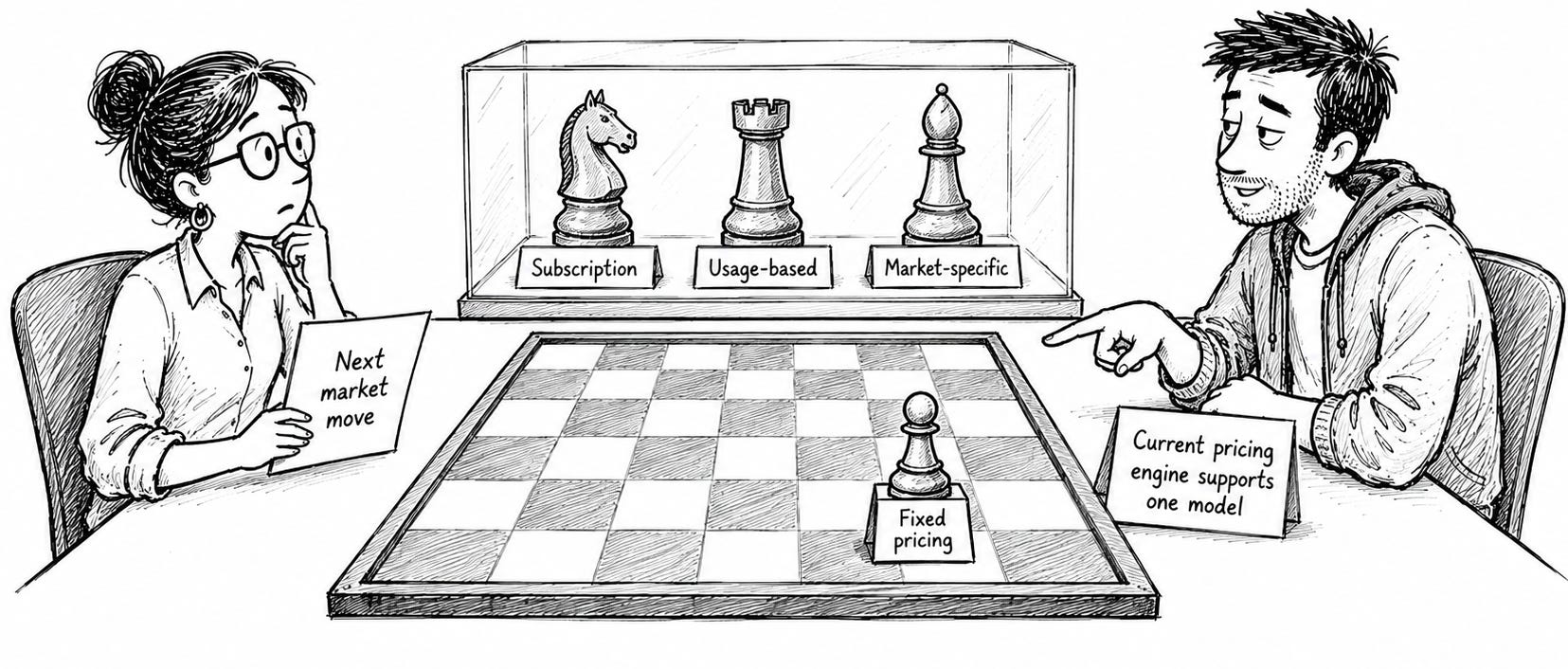
Show what the debt is blocking, not just what it's breaking.
For example, certain technical debt may prevent:
Entry into a new market
A partnership or integration
A pricing change
Personalization
etc.
This is the most persuasive for Product Owners because it speaks directly to the roadmap. Technical debt is not only a maintenance tax. It is a tax on innovation. Every hour spent working around legacy constraints is an hour not spent on new value.
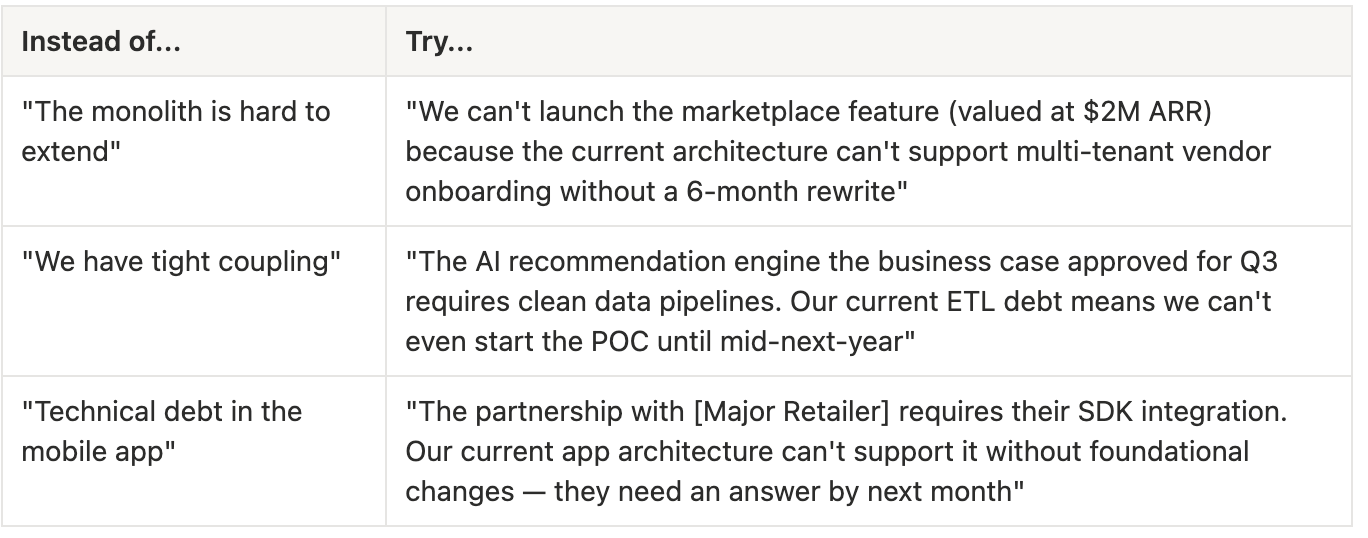
The Scrum Master’s Role:
Map the debt to the roadmap.
Create a simple “Blocked / Delayed / At Risk” view showing which planned initiatives depend on resolving specific technical constraints. This turns the conversation from “Can we afford to fix this?” to “Can we afford not to?”
Decision-ready question:
“Which committed roadmap item is at risk if we don’t address this debt, and what’s the business value of that item?”
#5: Decision Horizon
Make “time” a visible variable in the decision.
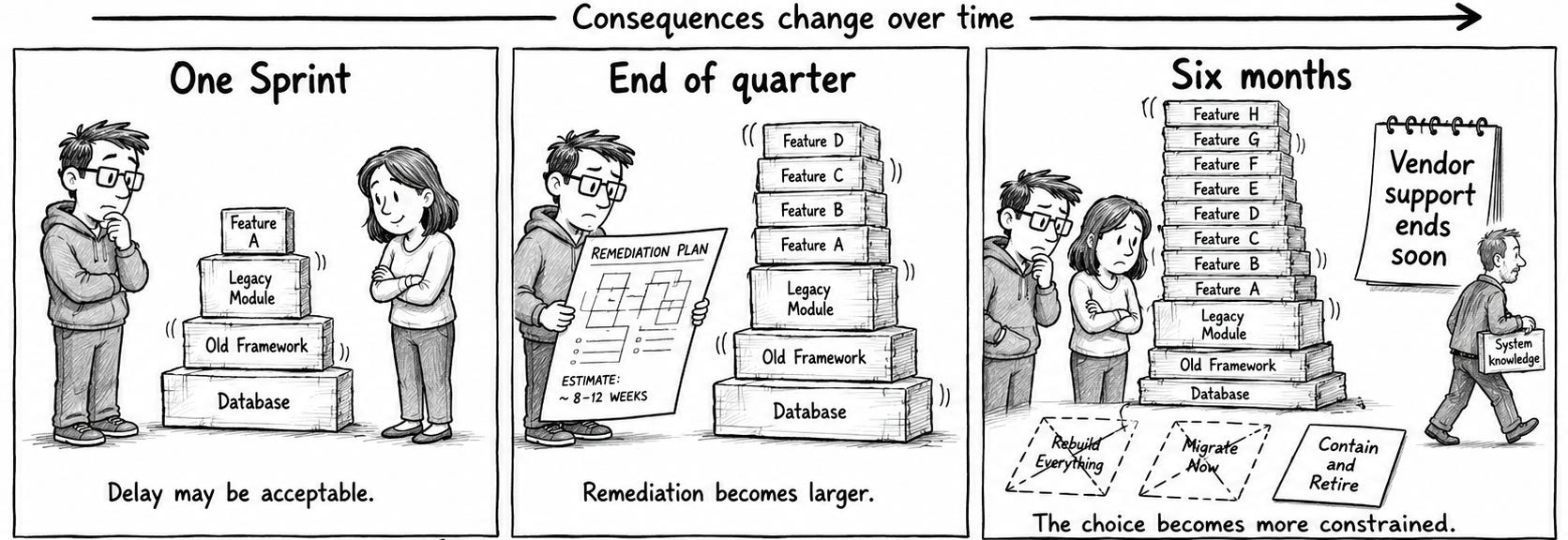
What teams need to explain is how the consequences “change over time.”
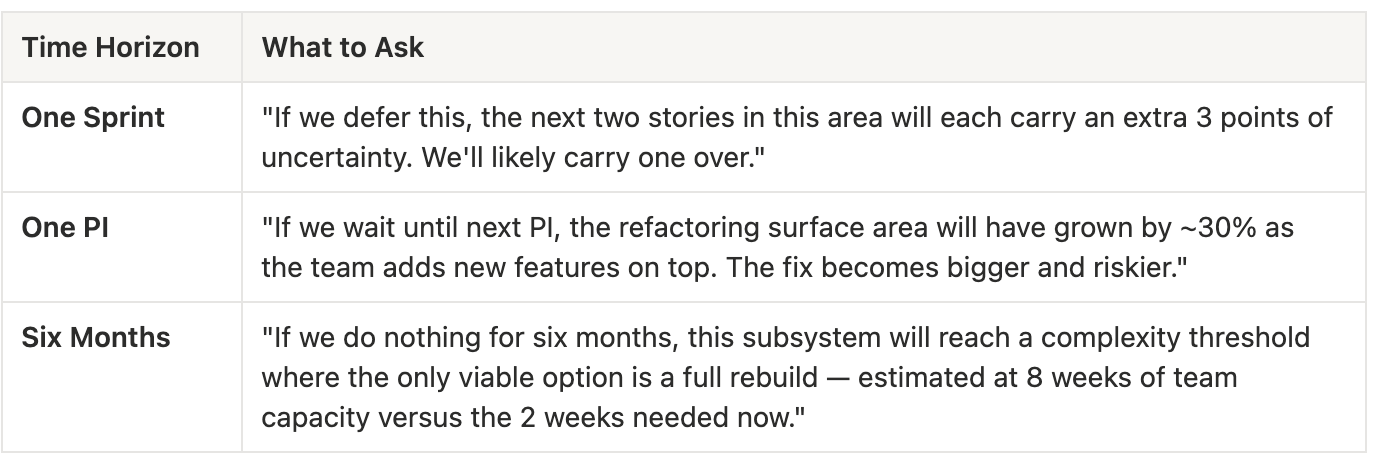
That is the decision horizon, and it works by comparing what happens if we act now against what happens if we wait:
For example:
What happens if we wait one Sprint?
What happens if we wait one Program Increment or quarter?
What happens if we wait six months?
Is the cost of action likely to rise?
Will the team still have the people and knowledge needed?
Is there an upcoming event that changes the risk?
Honest answers to these questions turn an unclear warning into trade-offs the Product Owner can choose between:
The horizon can also show that immediate action is not needed:
“The debt is currently an issue, but the affected capability is scheduled for retirement in four months. So containment may be more sensible than a large redesign.”
That is still a successful technical debt conversation.
#6: Investment Options
Give the Product Owner options, not ultimatums.
Most technical-debt conversations are presented as a choice between fixing everything and doing nothing.
Fund the full technical solution, or
Do nothing
The best technical debt conversations end with a decision.
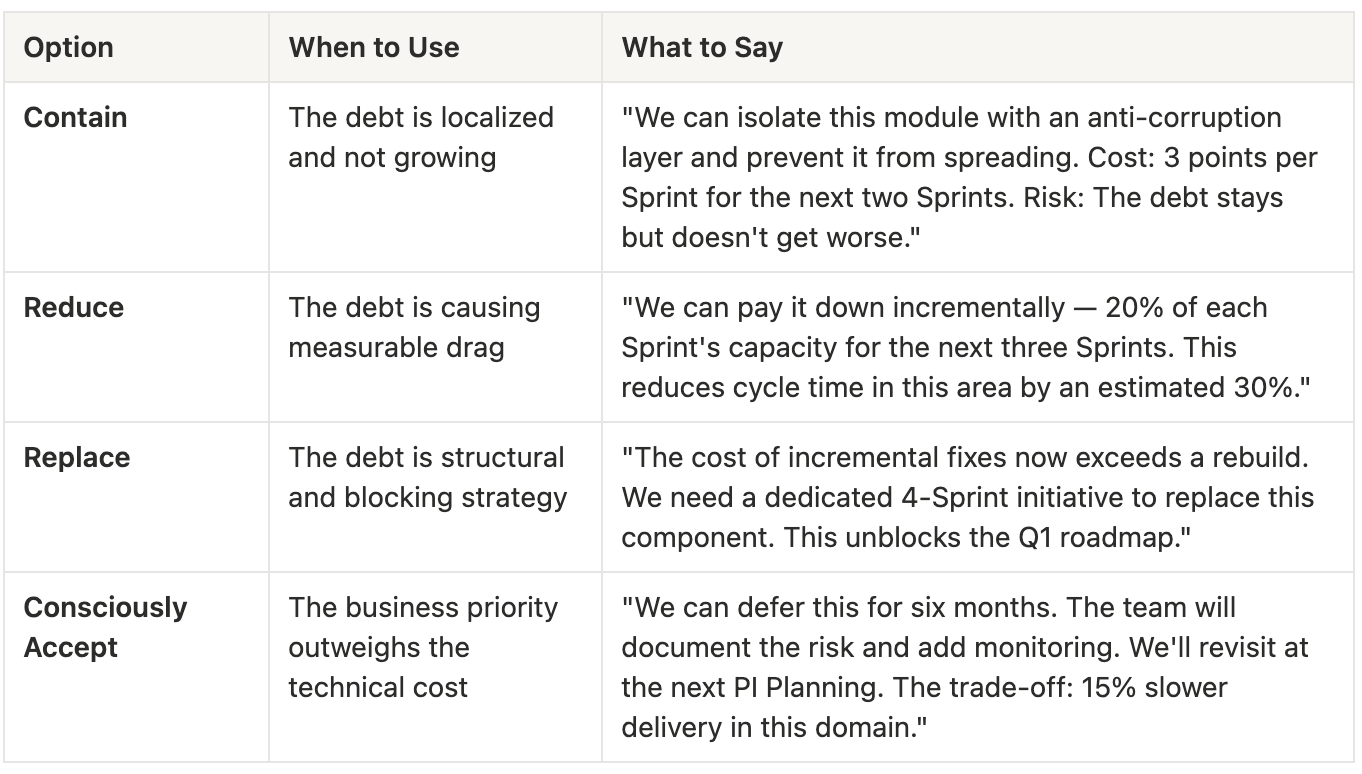
Product Owners are decision-makers; they need clear options with trade-offs. So we must present the debt as a portfolio of investment strategies.
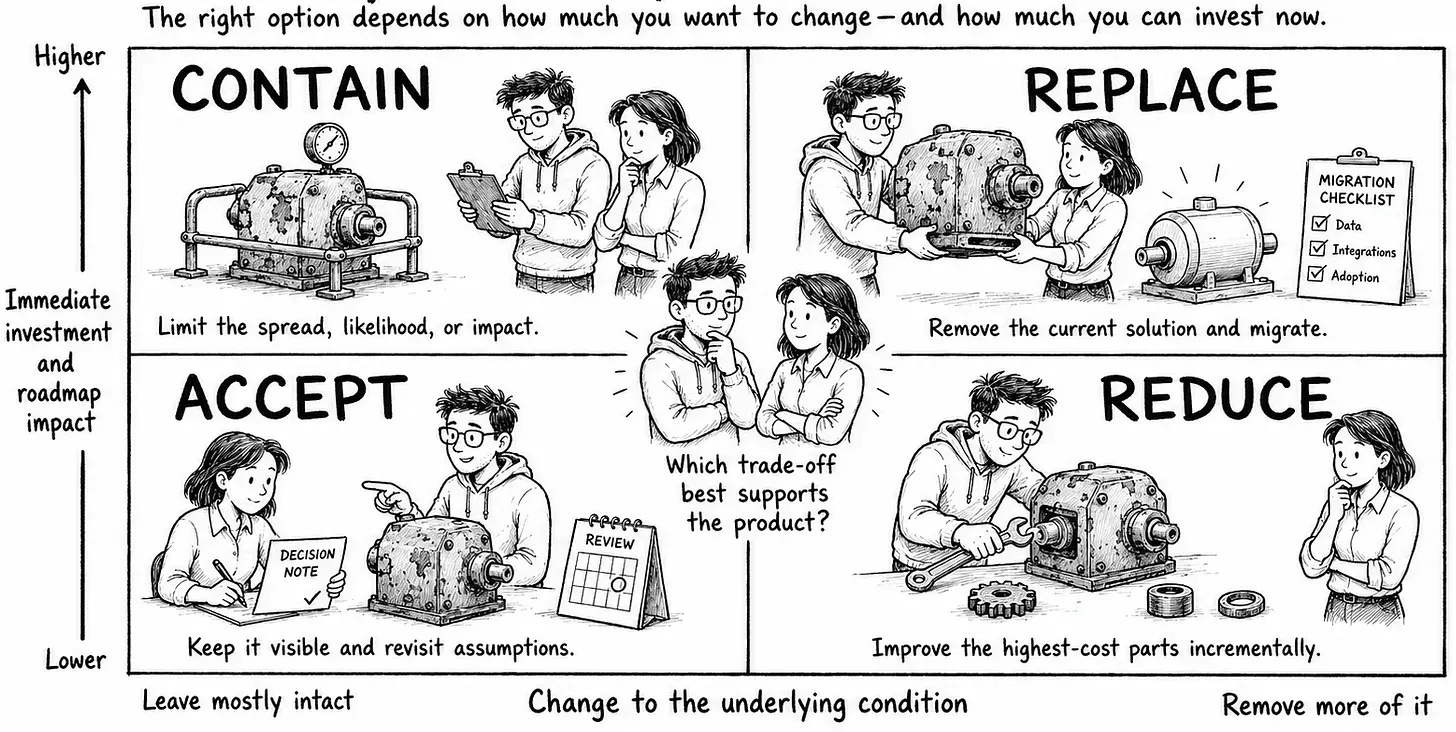
The Scrum Master’s Role:
Facilitate a decision workshop. Don’t let the team present only one option (”we must refactor now”). Prepare 2-3 viable paths with capacity estimates, risk levels, and business implications. The Product Owner chooses, and the team advises.
Decision-ready question:
“Given our current roadmap and capacity, which of these four strategies aligns with our risk tolerance and business goals?”
Putting all six together in an example
Consider this initial tech debt statement:
“Our automated tests are inefficient. We need a Sprint to fix them.”
The concern is genuine, but the request leaves some questions unanswered:
Which tests?
What problem are they creating?
Why one Sprint?
What improvement should the investment produce?
What happens if the work is deferred?
Are there smaller options?
Now translate it through the six ways of presenting.
Customer impact
Defects in account registration are reaching customers because failures are not detected consistently before release.
Delivery drag
The team spends one to two days per Sprint rerunning unstable tests and manually checking registration flows.
Operational risk
A failed registration release could prevent new customers from creating accounts, while diagnosis is slow because test failures do not reliably identify the cause.
Opportunity cost
The team is reluctant to experiment with registration because every change requires extensive manual regression testing.
Decision horizon
Deferring for one Sprint is manageable. Deferring for a quarter means that three planned registration experiments will carry the same testing cost and release risk.
Investment options
Contain: stabilize tests for the most critical registration path
Reduce: replace unstable tests incrementally as registration work is performed
Replace: redesign the entire test suite and test architecture
Accept: continue manual validation and absorb the current delay and risk
The resulting product conversation might be:
“Our unstable registration tests consume one to two days of capacity each Sprint and allow some defects to reach customers. They also make the team hesitant to run registration experiments. We could stabilize the most critical tests now, improve them incrementally alongside the planned experiments, or make a larger investment in the test architecture. Which option best supports the goal of increasing successful registrations this quarter?”
The subject is still automated testing. But the decision is now about customer acquisition, delivery capacity, risk, and investment.
Tech debt presentation template for teams
Teams can use this in Product Backlog refinement, as a follow-up to Sprint Review, in roadmap discussions, or in risk conversations. It fits on one page, and it forces every question a Product Owner is going to ask anyway.
The technical condition is: [Brief description]
The observable effect is: [Customer impact, delays, rework, failures, or constraints]
This matters to the product because: [Outcome, objective, opportunity, or risk affected]
If we wait: [Effect after one Sprint, one quarter or PI, and six months]
Our options are: [Contain, reduce, replace, or accept]
We recommend: [Option and reasoning]
The decision required is: [Explicit trade-off or commitment]
We will know it helped when: [Observable success measures]
Finally… how to help the team make the choice visible
As a Scrum Master, resist becoming the person who translates engineering into “business speak” behind closed doors. That can make you a permanent bottleneck and increase the divide between Developers, PO and stakeholders.
Bring the people into the same conversation.
Help developers explain what they have observed, rather than only what they dislike
Help the Product Owner explore consequences rather than demanding a financial return for every engineering concern
Help leaders clarify their tolerance for operational, delivery and market risk
Technical debt is not automatically bad.
It can be the result of moving quickly or testing an idea. Just as taking on financial debt can be a sensible decision, taking on technical debt can create valuable options.
Show your support
Every post on Winning Strategy takes 1 full day of writing. You can show your support with small gestures.

Liked this post? Make sure to 💙 click the like button.
Feedback or addition? Make sure to 💬 comment.
Know someone who would find this helpful? Make sure to recommend it.
I strongly advise that you download and use the Substack app. This will allow you to access our community chat, where you can get your questions answered and your doubts cleared promptly.
Further Reading
Connect With Me
Winning Strategy provides insights from my experiences at Twitter, Amazon, and my current role as an Executive Product Coach at one of North America’s largest banks.